
Original PWIA website
Redressing gender disparities in academic promotion through independent review of applications
This service is no longer available
Why this content is now archived here for reading purposes only
The original PWIA website was designed in 2020 as a service to universities to help them redress their gender disparities in academic promotion by providing independent review of applications from women. It reflected naive benevolence that perhaps management were just too far from the ground, and so would value a conduit from outside the system. Their failure to take up the service across two years of being open made me realise that their gender disparities are not something they wish to correct because then it would mean admitting that an injustice needs correcting and that their processes are not meritocratic. The website was supported with information that allowed women (and men) to better understand the system they are working in, and therefore better able to make informed and empowered decisions about their career planning. The text (i.e. not images, layout etc.) from both the (1) SERVICE and (2) RESOURCE pages are now archived here for reading purposes only. While the service is no longer open, and neoliberal academia has exponentially ‘metasised’ since, the discriminations embedded in a capitalistic knowledge-production system remain. Archiving the efforts to correct them is important for the preservation of history. Frankly, putting it all down on one page - despite the many positive reviews I obtained for the service in 2020 (see below) - makes me feel sick at how much fawning, fighting, and fleeing I’ve had to do to survive an industry I was supposed to be able to build a decent livelihood from and feel good about my contribution to society. There were two self-help tools I developed for women planning their promotion, which can still be purchased from the site Store.
1. Service
THIS SERVICE IS NO LONGER AVAILABLE. THE INFORMATION HAS BEEN ARCHIVED HERE FOR READING PURPOSES ONLY. This honours the intellectual and emotional labour of women of colour academics that underpins their desire for system change even if those efforts fail. It also helps people in the future to learn from what has and has not worked in the past.
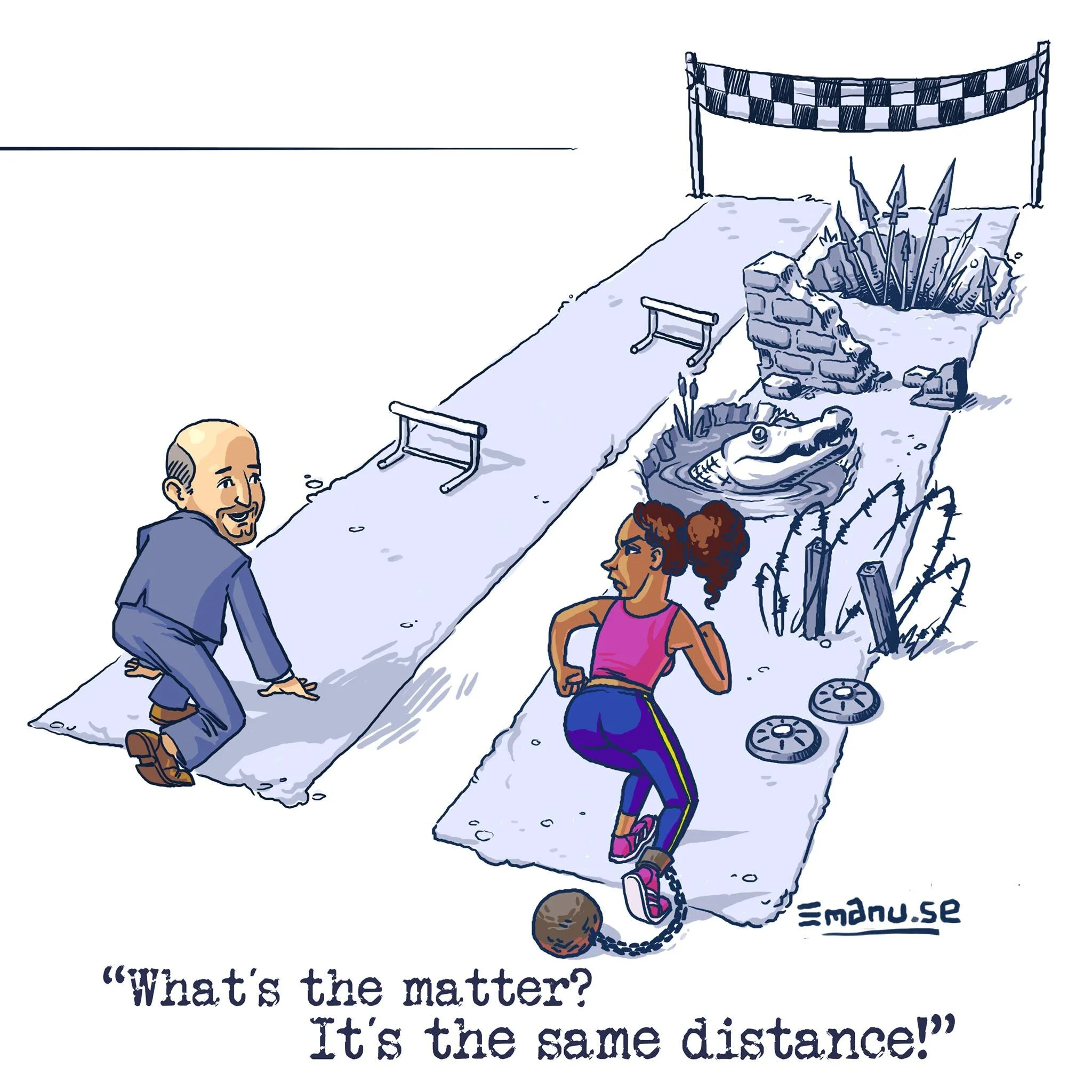
-
My original consultancy was available for more than two years, and while several women took up the services designed for them not one university did. They were the primary target client because this service was designed to assist a defunct system, not its (presumed defunct) people. It shows complete lack of will because universities already know that (investing in) gender parity in professorship hurts their bottom line which is all they care about. They also do not wish to take advice from a woman of colour. They always win. They have too much power. Stark inequity is a design by intention. This announcement, sadly, is to say that the part of my consultancy designed to engage with universities is no longer available. All of the information about that original service has been archived for reading purposes only. I have done this to protect and preserve the emotional and intellectual labour that underpinned the service design, and to honour the workplace trauma and injustice I continue to survive. I wish to thank the women who thought the knowledge of a woman of colour was worth paying for (i.e. reviewing their draft applications for promotion). I hope this site gives you some of the oxygen you might have been looking for when you came to it.
Dr Pooja Sawrikar, September 2022
-
It’s a naturally occurring human cognitive bias, where we attribute the cause of someone’s behaviour to internal factors such as their personality rather than to external factors such as their lived experiences even when they are clear/obvious. We do this to reduce the amount of empathy and therefore responsibility we feel for others’ misfortunes. This helps preserve limited time and attention for ourselves; a self-protective mechanism that boosts our chances of survival. I raise it here to ask that you keep a check on it in yourself. It is too easy to think that I am crazy (‘personality’) for being so overwhelming with my many words. Instead, I ask that you see these as the gift of knowledge. It is overwhelming. Much is being shared because much has been forced to be learned - it’s what happens the less the status quo serves you. I ask that you work through this site slowly rather than tune out or place it in the ‘too hard’ basket, so that the cognitive load of being a woman (of colour) in neoliberal academia is at least seen.
-
Are you a university looking for independent advice on how to promote women to Full Professor at the same rate as men? Do you want to move beyond the ample evidence of gender inequity and well-intentioned strategic plans, and really implement the equitable upward mobility of women? This service can help you. It meets 3 of 12 recommendations made to the Australian Vice-Chancellors Committee (AVCC).
Recommendation 10: That all universities include in promotions policies and/or guidelines a requirement that an EEO (Equal Employment Opportunity) representative or person with an equity brief be involved to monitor the process and the results to ensure that cultural and equity issues are addressed.
Recommendation 12: That all universities implement special initiatives to encourage and assist women applicants.
Recommendation 8: That all universities include in promotions policies and/or guidelines a requirement that committee chairs and members complete training on gender equity prior to the first meeting of the committee.
I understand how academic progression works; I will ensure you feel safe to speak as you navigate confronting information; I am unafraid of the size of this challenge; and I am using my experiences to help future women scholars receive timely recognition, and universities meet/exceed the gender targets they have set for themselves. In this service:
Universities: can get independent reviews of womens’ application for promotion to increase the transparency of their decision-making and boost institutional reputation.
Women: can get non-gender blind support and editing for their application for promotion to help fully convey their worth and boost their chances of success.
Funders: can get independent reviews of research grant proposals to increase womens’ equitable representation as thought leaders.
-
You show your women scholars that you are doing the most you can to redress gender inequity and not resting on laurels.
You provide your women scholars a confidential outlet to disclose all the barriers to career progression they have experienced.
You make more informed and confident decisions by engaging with someone knowledgeable and trustworthy to speak the truth, while simultaneously being safe and professional.
You increase trust and transparency of the process of academic progression.
You acknowledge and address the real problem - not individual women, but structural differences in power and privilege.
-
1:1 coaching for women scholars on draft applications for promotion.
Safe facilitated workshops for university decision-makers on setting gender equity goals.
Seminar presentations and keynote addresses on gender inequity in academia.
Independent review of journal articles for editors preliminarily considered unsuitable for full peer review.
Independent review of grant applications for funders for proper appraisal of performance relative to opportunity.
UNIVERSITY PROMOTION COMMITTEES: I provide universities independent review of applications for promotion thereby increasing the transparency of their process, and my recommendation is more informed of how to adjust for unequal access to opportunity for each woman scholar that is reviewed.
WOMEN SCHOLARS: Using your current draft application, we will talk through your specific professional experiences to date and your plans for the future, so that how you finally tell your story about why you are such an asset to your university and worth recognising and investing in is as clear for them as possible. Your academic level should always be commensurate with your qualifications, knowledge, and experience - not below it.
UNIVERSITY EXECUTIVES: I provide opportunity to decision-makers from all faculties to come together and deeply and safely reflect on their current gender equity strategies, quotas, policies, practices, and plans. You may be stuck in a conversation that is not progressing well, and an independent informed consultant is a good circuit-breaker for getting things moving again at the pace required.
CONFERENCES/WEBINARS: It’s a complex conversation, no doubt. A less confronting way to engage with that complexity is to just listen and learn. Humans are quick to defensive reactivity, and researchers are quick to critique. Dadirri is an Aboriginal word that means to actively and deeply listen. If you will be so kind as to do this for me, I will be so kind to oblige.
JOURNAL EDITORS: If you recognise that you have immense power to gate-keep knowledge, have been trained to value quantitative data and western empiricism above all else, receive angry emails from women who can write articulately, and/or feel a tussle with wanting to protect your journal’s reputation, I have ears that are willing to listen and see you through to a final decision about whether a paper should be sent out for review and how to treat her respectfully throughout the peer-review process.
GRANT FUNDERS: If you have shortlisted a woman scholar with a project proposal that reviewers unanimously agree is exceptional, but they differ in opinion about the size of her track record because some are falling more than others for ‘the numbers game’ that neoliberal academia reduces intellect and impact to, then I can conduct a more sensitive, precise, and accurate independent review of her gendered performance relative to opportunity to assist in your final decision-making.
-
It depends on separating productive from reproductive labour, treating the latter as a naturally occurring resource to be exploited, with no means made for replenishment. She creates and cares for the workforce for free. Currently, there are no independent review bodies governing how universities conduct their business. They are an unregulated ‘marketplace’. When universities make their own choice to engage in independent processes that increase the transparency of their systems, the invisible organisational trust that is bought is without bounds. A small investment goes very far. Find out the fee structure for independent reviews so that we can get started on making your university seen as trustworthy.
-
Understandably, the most popular ancillary service is coaching. But women don’t need to engage this if they know they don’t really need it or can’t afford it. The historic and systemic devaluing of women is not their problem to fix.
Do you want a fairer assessment of your application?
Are you a woman scholar who wants a fairer, more transparent, non-metricised assessment of your application for promotion? Do you want an independent ‘foot-up’ to help your worth be more accurately seen by your university?
If you have a good idea about how to write a promotions application, but are still concerned about possible gender-insensitive decision-making, then contact me. I can let your university know that you want an independent review of your application.
Some of us already hurtfully know that good hard work is not enough, nor is it equally rewarded. If you know you have done your best effort with your application, the cost of correcting for injustice does not belong to you.
If universities can’t see how much money you’ve made them, you’ve got a slog on your hands. Neoliberal academia treats human capital as a financial liability (not an investment) until that person can prove they are a financial asset. I’m here to help you safely explain why that money was not easy to come by, and why you are still equally valuable to the core business of teaching and research to someone for whom it was easier. The university is its staff and students, not its management. You are not inferior to them, and they do not have special knowledge over you.
Coaching is best for women scholars:
Whose professional experiences have been so unjust that having an empathic ear to talk it through would be helpful.
Who have not been through the promotions process before, or at the higher levels, and so have no real idea about expectations.
Who want to learn about the game of ‘self promotion’ and then make empowered self-determined choices about how to speak like the woman and person they are.
Who do not have access to free independent review of their draft application from colleagues.
Who want a careful double-checking that each criteria for promotion has been fully written to.
Who want to talk about how and why academic progression became so difficult and unfair to better understand their own experiences, and/or
Who would just feel better having knowledgeable independent eyes check their application before submission.
Good work does not speak for itself (hard to believe, I know)
What is deemed good depends on who is judging it, why they are judging it, and what they are looking for. If it sounds like what they would write - it feels familiar - it gets a higher rating. If they have nothing to part with - like more salary to budget for or potential threat to reputation - then it also gets a higher rating. Ask for a testimonial and watch the generous positive comments fly in. Ask for a review and you’ll scratch your head at how the same piece of work could attract such scathing or unpredictable feedback. Make sure the right people are on the panel deciding the worth of your labour and ideas. I’m here to be one of those voices. I’ll be looking for reasons to rule you in.
-
When does a ‘shadow CV’ - the typically unseen list of rejections and failures - move from being something that grows grit and resilience to something that reveals structural sexism? Here is a copy of the Call (2021):
Dear Colleagues,
Gender inequity in academic progression is a well-established and well-acknowledged problem, with many well-intentioned strategic plans to help address it. However, the rate of progress is painstakingly slow. According to Savigny (2014) [1], it will take 119 years to reach equal numbers in the professoriate at the current rate of promotions and appointments. Excluding Iceland, the best reported proportion so far is one female for every three male full professors (Crimmins, 2019) [2]. These statistics are damaging to women’s professional and self-esteem, leading to a raft of self-policing behaviors that acquiesce to covert messages to ’stay in one’s box’, which they are also then blamed for later. It is a self-fulfilling prophecy, hostage to a history that has never known how to equally value the work and worth of women. The ‘maternal wall’ is the primary reason women meet the glass ceiling at mid-level and struggle to go beyond it at rates comparable to men, but women without children struggle too, caught in the invisible insidious web of gender.
Contributions to a Special Issue dedicated to gender equity and academic progression may feel like achieving little more than narrative therapy for the authors in the short term, but in the bigger picture they do two things: they provide a time-lined snapshot of how the goal is tracking, and they keep it on the table. All the talk about gender can make people tire of it, or believe we are closer than we are, revealing their commitment as tokenistic and their understanding as cursory. Moreover, every type of evidence matters; economic modelling of intellectual prowess lost, correlational trends of patterns faring better or worse, and personal accounts that capture nuance which numbers cannot reach all have their role to play. Perhaps above all this, allyship from men seeking their own liberation from toxic masculinity lends power and privilege in positive and egalitarian ways.
Women differ among themselves. Gender intersects with race, age, class, sexuality, faith, and dis/ability to produce even more barriers. Young up-and-coming scholars, filled with a sense of agency about life and its possibilities, will not be able to see representatives and mentors they can seek out to help guide them through the trajectory of academic progression. That panel of “experts” will invariably look the same, and the message she will receive without anyone having said a word is that ‘you will not have knowledge considered expert or worthy publicly; pats on the back are the best it will get, be grateful for your breadcrumbs’.
There are three main types of power one might chase: time, money, prestige. The first two are more quantifiable. If a woman works in a government agency, overtime is paid close attention to and a rostered day off is offered in lieu of it. The power she gets is mental health, from being able to better manage the various aspects of her life especially the unpaid component of keeping house and caring for children. If a woman works in a corporation, overtime is also paid close attention to and a bonus might be offered in reward of it. She gets purchasing power, including the ability to hire a clone and fill ‘the wife drought’ (Crabbe, 2014) [3] by outsourcing parts of the unpaid work she would otherwise do. However, the overtime work that women in academia do is not paid close attention to, and the rewards are handed out sparingly. A woman’s exploitation is wrapped in rhetoric that she is lucky to be able to do intellectually free work with flexible work arrangements. In fact, such an assumption requires deep interrogation. When a reward becomes extremely difficult to attain, because leadership within a field is not easily quantifiable, and unconsciously compared to the white male prototype of intelligentsia by decision-makers with false presumptions of equality in access to opportunity, it begins to taint her desire for the goal and the sweetness of it when she does get there.
When a woman expresses desire for the title of Professor, she is seeking a nebulous form of power in the form of recognition and respect for expert knowledge. However, who such a person can and should look like is rigged from the start; hard work is not enough. If you have something to say about this, and would like to lend your expertise and experience to this issue, I welcome your voice—every one counts. Manuscripts can touch on any aspect of the topic of gender inequity and academic progression, and the possible points of contemplation listed below are not exhaustive:
Neoliberalism, research, and teaching—Can you offer long-range reflections on what academic life was like pre- and post-neoliberalism? Can it really be called ‘academia’ anymore when the focus is so heavily on teaching—is it really just ‘higher education’? If research is so valuable for academic promotion (e.g., publications, citations, grants, etc.), why is investment in its opportunity to conduct and support it low compared to the amount of teaching allocation?
Intersectionality—What has it been like for you in terms of being recognized for your intellectual labor as a person of color, an older or younger person, being first-in-family at university, a member of the LGBTIQ+ community, of Muslim or any other faith, and/or having a dis/ability? What is your hopefulness for becoming Full Professor?
Discipline—How are the STEM disciplines faring in progressing gender equity and academic progression compared to the social sciences? Are there hidden social forces of oppression even in numbers that look more equitable? The desirable outcome may have been attained, but at what cost? Was the process gender-disaggregated and sensitive?
Scholarship—How much intellectual freedom do scholars really have? What does the power of senior mentor researchers do to the creativity and track record development of junior researchers? Are journal editors and reviewers gate-keeping knowledge and controlling the freedom of ethical speech? How does a mid-level scholar break out to become an independent critical thinking pioneer in her field?
Work–life balance and caring—Should flexible work arrangements such as working from home at any time be a positive legacy of COVID-19 as a means to increase gender equity in academic progression? Should the unpaid hours men contribute to domestic affairs, the unpaid caring for children that women do, and the unpaid emotional labor women contribute to their students be factors considered in academic progression?
Budget allocation—Are there small wins in your field you wish to share and celebrate? For example, has your university had a major financial restructuring that more equitably supports research ambitions, diversity in teaching opportunities, and access to professional development and networking, all of which are translating to a fuller application for promotion a woman can prepare because she meets criteria she does not have to fund from her own lower-salaried pocket?
Out of respect to authors, reviewers will be reminded to provide collegial comments rather than criticisms, so long as the work is ethical, readable, properly justifies the fit of their chosen research methodology to their chosen research question, and properly acknowledges the strengths and weaknesses associated with that methodology. That is, final say about what stays in and out of the manuscript’s scope will belong to the author, if it meets these criteria for publication. Applications submitted before article submission are assessed by the Managing Editor based on the quality of the research article and the authors’ ability to pay. Please feel free to inquire further before proceeding to a full manuscript submission (article/review/conceptual paper), as only those directly relevant to the topic of gender inequity and academic progression will be accepted. An initial scoping of the relevancy of your idea can be offered if you are unsure.
I look forward to receiving manuscripts from a wide range of scholars to help make sure the academy celebrates its women’s intellect, creativity, innovation, caring, kindness, and strength, with rates of academic progression that match their male counterparts. Women have always been excluded from positions of leadership, so the world does not really know what it is missing out on and therefore what it needs to protect. Representation at the top—in all aspects of society, of which academia is one microcosm—should be proportionate to representation within the broader population, else there is an abuse of power and privilege remaining largely unexamined. Un/conscious protecting of self-interest and un/conscious intention to exclude women are serious challenges that society is accountable to answering.
-
Truth is hard for everyone: This website contains information that will be hard to read - for those not already thinking about it, as well as those living it. Neither of these predictable outcomes can be helped. When truth is spoken it is uncomfortable, yet truth is the path to change.
“Statistics are human beings with the tears wiped off” Paul Brodeur
For every woman recognised as having a level of knowledge that she can profess, there are three, four, five, sometimes more men [1]. In western multicultural countries like Australia, US, UK, Canada, and New Zealand, it has taken over 40 years to double the proportion of female Full Professors from 12% to 24% [2]. At the current rate of promotions and appointments, it will take more than 100 years for women to achieve equal numbers in the professoriate [3]. He gets there quicker, because the system was built for him. When a woman sees these statistics, she painfully asks herself: Is my knowledge really just not worth that much? What have I been working so hard for?
Answering these hard questions requires hard conversations about: Sexism - Feminism - Patriarchy - Unconscious bias - Intentions / effects - Misogyny - White privilege - Intersectionality - Racism - Neoliberalism - Work-life balance - Toxic femininity - Toxic masculinity - Social justice - Mental health - Hope - Anger - Good / bad humour - Bravery - Presumed agency - Presumed competency - Exploitation - Myth of meritocracy
It is overwhelming and impossible not to take personally. It shows why we can’t privilege the pain of women in academia without alienating those with the power to change it. Unlike its complex context, the philosophy of this service is simple: Believe the pain. Adjust for unequal access.
Calling on the help of an independent consultant who has already done all this deep thinking can boost confidence in your final decision about academic performance relative to opportunity. Time is not lost questioning the legitimacy of her knowledge or injustice. Instead, time is used to recognise her properly calibrated value and boost parity in career progression. This is more than just about the academy. When she thinks of leaving because no one really sees her, the accuracy of the world’s knowledge leaves with her.
-
Unconscious sexist bias and ensuing discrimination cannot be helped - its history, stereotypes, and self-fulfilling prophecies are thousands of years in the making - but that doesn’t make it exempt from at least trying to hold it to account.
White women, women of colour, women with children, women without children, step mothers, single mothers, single women, larger women, body-conscious women, women with disabilities, children with disabilities, gay women, transgender women, binary-suffocating womyn, poor women, women who have been sexually assaulted, women who wear hijabs, women with names not easy to say, women with accents, older women, younger women – we are not the same; some of us are more privileged than others with less intersecting systems of oppression to navigate.
But we still share something: that we want to be seen for the women we are, not the men we are not.
Feminists are well versed with the adage ‘women work twice as hard to get half as far’. Neoliberalism privileges research over teaching, individualism over collectivism, and positivism over constructivism. These hierarchies favour men. They also in/explicitly require self-promotion and salami publishing. But women are either turned off by these expectations or do their best to keep up but just can’t. It is not women that need changing. It is the system and those who manage it. Applicants receiving mentoring helps, as does universities that get gender equity training, but something is still amiss. We talk more than we do. The rate of progress is too slow. Budgetary pressure is capitalising on invisible social forces. White privilege and patriarchy ensure that leadership is not as diverse as the pool of talent from which they came.
The same unconscious biases have systemic tilted power.
Change comes from doing things differently. Fresh non-white non-male eyes are needed. The consultancy service offered here is independent assessment of applications for promotion, that more sensitively takes into account low research opportunity, caring responsibilities on and off the job, team-based work, and previous industry experience; all of which are known to be possibly overlooked, yet continue to be too. Universities can use these reports to finalise their decisions. They can be brave and ask, “what can’t I see?” (braver still and ask, “what don’t I want to see?”). When decision-makers hold on to “…but I didn’t mean it”, it allows the rhetoric of gender equity be to seen as having done enough.
Who’s an expert?
Less than 2% of Full Professors in Australia, US, and UK are women of colour [1], forgotten and left behind at the intersection of multiple ‘isms’. Accessing the services of a woman of colour is itself a demonstration of trying to do the right thing. It is handing over power to someone whose knowledge is “unconsciously” devalued. While it is not right by Indigenous people, it is true of human nature and history: immigrants want their “fair share” of the economic spoils of colonialism, but they are underestimated by those who are overestimated.
-
I could have done anything
The quagmire of how we as a species came to devalue women to the extent we do is so vast that I can’t put my arms around the problem and hold it; its breadth is uncontainable. In its full horrid scope it includes abuse, neglect, violence, rape, death, exploitation, trafficking, slavery, silencing, manipulation, minimising, belittling, objectification, fear, denial, harassment, exclusion, and control. If you have not experienced these things first hand, it sounds surreal; a defense mechanism to cope with the shock. But disbelief adds insult to injury. Burden of proof falls on the already crushed victim. You also never get personally outraged enough to want to fix it, keeping the same predictable injustices in place. I can only do my one little part. This is what I chose. You can learn more about the journey that led to this point here:
Research grants | Pay gap and publishing | Sense of agency bias | Feminist university strategic plan
Academia struggles to see viscous encumbered gender that women scholars do their work amongst, through, between, around. After 20 years of service to the industry, I was on my way to being another statistic: a hard-working woman who would become a tribal elder that others borrow wisdom from but lived in poverty. Take well exceeded give. My ‘professional age’ and its value fight to be seen. Once finally recognised, it is the first on the ‘cheaper replacement chopping block’ during times of financial duress. Archaic status quo assumptions that women live in households with access to a man’s “superior” income-earning worth and ability must go. Her work and her worth stand alone. Just because money is something we all need and want, it does not mean capitalism is the great universal leveller: it just widens the disparities in opportunities along other socio-politicised categories.
Is advocacy for justice thought leadership or trouble making? When thought leadership is a prerequisite for Full Professorship … Houston, we have a problem.
Corporate feminism: I’d like to say this service is in no way ‘neoliberal corporate lean-in feminism for the 1%’, but I can’t - I work within limits that create contortions, complexities, and contradictions. But I can say that status and money are secondary drivers - foremost, my work is driven by the desire for the wisdom of women to be systematically valued. It is not the title itself that is being chased (power for power's sake), it is the respect that title signifies (earned and recognised knowledge power).
'Woman's inhumanity to woman': Excluding many modernised/urbanised families in India, it is common knowledge that the mother-in-law is mean to the daughter-in-law. The devaluation she navigated when once the daughter-in-law herself will eventually contort her into policing the patriarchy. Men can sit back and let women do the work of keeping the system in place. The new daughter-in-law will wonder where her empathy went, having walked in those very shoes. She may even find refuge and support from a man within the extended family network structurally powerful enough to afford to be softer and more benevolent. The playing out of social forces as a result of gender power imbalance and entrenched patriarchy are neither simple nor kind. The parallels as they play out in western corporate/mercantile feminism are that sometimes a woman expected to be ‘on side’ fails to be, and the man expected to not is.
Why you're here: This website may come across your screen at any point in your career or cause any number of emotions. Maybe you are at the beginning of your career and feel rage with solidarity, which you can express because you have nothing to lose. Maybe you are mid-career and want nothing to do with all this ‘gender business’, distancing yourself from the tarnishing brush of the risk that comes with speaking up; you keep your head low, so that you can just get over the line. Maybe you’re older and not so angry or threatened anymore, so you simply smile knowingly. Wherever you are, I honour why you are there.
Beware the glass cliff
“What can you do to keep women out of powerful positions? Set them up to fall” Ijeoma Oluo
-
Universities in Australia and worldwide can obtain independent assessments of applications for promotion that they are unsure of and would appreciate a second opinion on.
The assessments will be thorough, and will contact applicants for further in-depth contextualising information that they may not feel safe to provide through written or verbal means to their employer.
The assessments aim to appraise academic performance in relation to better adjusted expectations of them, as women.
The emphasis will be on the value the applicant brings to the university as a whole person across her whole career and all parts of her life; it will not simply adjust her countable achievements since last promotion.
The reports will protect the applicants’ right to anonymity and privacy, so will not provide verbatim quotes.
The reports will be strictly confidential to the commissioning university with final decision-making responsibility.
The cost will depend on the number of applications the university would like assessed.
Applicants can ask their university to engage this service*.
Stereotypes of men that fail to address their diversity can sometimes favour them and sometimes not, so universities can also seek a second opinion on men applicants.
*Applicants need to check their university’s promotion policies as to whether paid external independent assessors can be additionally added to the review panel. If not, requests to repeal this exclusion can be made on their behalf, in line with the AVCC recommendation that an ‘equity and diversity’ representative monitor the process.
-
Many universities put a freeze on promotions in 2020 due to the pandemic. Its longer term impact on acknowledgement of work effort and care for others, attitudes about distance learning, understanding of working from home, and compassion for juggling caring, are also yet to be better understood. I look forward to working with you as you move toward better gender equity at a time when shifts in workplace culture have settled. I also wish you well at this uncertain time.
If you are interested in taking part in a global study on gendered research productivity during the pandemic, please visit this website: www.covidgap.co.uk
Relevant articles
Feel free to contact me with links to relevant articles that I can add to this list.
Did our employers just requisition our homes? Associate Professor Fiona Jenkins, Canberra Times, 4 April 2020
Women academics seem to be submitting fewer papers during coronavirus Caroline Kitchener, The Lily, 24 April 2020
Research jobs set to go as coronavirus takes hold throughout Australian universities Sabra Lane and Claudia Long, ABC News, 11 May 2020
Coronavirus has left Australian women anxious, overworked, insecure — and worse off than men again Annabel Crabb, ABC News, 24 May 2020
Baby matters: Gender politics beyond Covid-19 and the “aunts” of academia Enrica Maria Ferrara, Academic Matters, 29 June 2020
In the wake of COVID-19, academia needs new solutions to ensure gender equity Jessica Malisch et al, PNAS, July 2020
Covid-19 has thrown the gendered division of work into sharp relief Jenna Townend, WONKHE, Oct 2020
-
What does an independent service offer more than what you’re doing already?
Universities are already doing a lot.
They get training in gender equity
They develop strategic plans with operationalised targets and quotas
They liaise with unions
They establish equity/diversity steering committees that include staff from all levels
They offer peer mentoring and women in leadership programs
They ensure there are multiple and experienced panel members thoroughly assessing each application for promotion
They ensure there is gender balance in the panel members assessing applications for promotion
They get assessed and certified as ‘a choice university’ for women, and
They really want to recognise all their staff’s achievements because they know a happy workforce is a productive one
But, decision-makers are likely to use the same schema used on them.
This is true of women also, who finally get the recognition they deserve (‘if I had to play the game this way and this hard, why is anyone else different?’). The pain of their story is under threat of being minimised. They also cross a ‘co-opted’ threshold, suddenly privy to new information, combined with a surge of power and agency, that reduces their empathy for the plight they trod. The new ‘speak’ they learn, which everyone around them is speaking too, works to rationalise and legitimate the status quo of social injustice; reasons for why it needs to remain (even unintentionally) are affirmed over and over by the language and emergent priorities of people with power.
Being hostage to history is a ‘pain point’ for us all. But with all our strength, courage, disappointment, and struggle, we still need to get passed it. We also can’t forget. Stark discrepancies in representation at the top feed false stereotypes and expectations that a man’s expertise is more valued and valuable than a woman’s. Women internalise their ‘lower worth’, feel helpless to strive, and are blamed for not dancing the delicate balancing act between grace and grit to ‘make it’ [4]. The behaviour of individual women comes under spotlight, and the structural barriers she navigates blur away.
It is the independent nature of this service that has a chance to disrupt this.
The in-depth assessment tool used in this service looks closely at the barriers encountered in the process of career progression, because a focus on outcomes keeps missing the real problem. It is not the criteria for promotion that are under question, but the degree to which unequal access to opportunity is truly taken into account. Women do not have the same power or privileges as men, so their hard-fought hard-won achievements and their value have a completely different meaning.
It is impossible not to essentialise in this conversation. But generally speaking, systems that value quantity of output benefit men, systems that value quality benefit women. As alluring as money is to universities (coming from all things numeric and easy to measure and benchmark, such as number of publications, number of citations, number of PhD supervision completions, amount of external funding attracted, high teaching evaluation scores, impact factors of journals, etc.), quality is equally essential. You can only claim you really value both when the proportion of women and men who are Associate and Full Professors, and their rate of progression through each academic level, are the same. Until that’s true the mismatch between rhetoric and reality needs deep honest examination: she is bringing in money to the university, in less tangible ways, and she wants to be seen for that.
There are also many disgruntled staff (rightly so) told to wait another one or two years to apply for promotion, after having waited decades already and mustered all their might to finally flag their desire for overdue recognition commensurate with their qualifications and professional and life experience. Engaging the services of an independent consultant helps build trust and transparency of the process.
The current ways of doing things are cursory and conservative, which is why the numbers are not really moving. Be bold! Do it differently.
Women bring to research their intellect, innovation, and creativity; to teaching their knowledge, communication, and interpersonal skills; and to leadership their wisdom, kindness, and strength. She does all this against the odds. But the system cannot keep helping her stay there so long as she acts like a man. No one can pretend to be what they are not. When dreams, passion, and capabilities are repeatedly thwarted and dwarfed because assessment of their worth is held to one standard (‘how many direct dollars did you bring?’), and the system is rigged at every turn with power not in your favour to reach that standard with reasonable effort and equitable ease (a fact the system likes to leave centrally unacknowledged), it will eventually make you ill. You will run out of puff. When migrants are free to be themselves and are not expected to assimilate - with unconscious assumptions of superiority faced, fear of loss put away, and control of power not wielded - harmonious co-existence, equitable power sharing, and deep regard for one another show up. As with race, so too with gender. If you have just a sliver of readiness to be uncomfortable and are willing to push through it, the gains on the other side are immeasurable for everyone.
If you are looking for a refreshing change - a mix of kind benevolence and unapologetic honesty - then you are in the right place. This mix will move good intention into good action.
-
Some people think that when 50% of leadership roles in every discipline are held by women we then have gender parity. Striving to reach such blanket absolute targets are problematic because they invite irrelevant harmfully stereotypic conversation about what women and men are presumed to be good at and therefore should stick to.
In an effort to appear that gender is being taken seriously, high-level roles are being given to women in traditionally male-dominant fields such as mathematics, economics, and engineering. The tokenism creates resentment among the clustered mid-level men and the woman works even harder to prove her worthiness for the job.
Healthy numbers can mask unhealthy stories. Shifting the focus to relative targets helps ensure that desirable outcomes are not reduced to a check-box activity, heavy with navigating accusations of ‘political correctness’. The number of women and men within a disciplinary leadership team should proportionately reflect the number of women and men disciplinary graduates.
Men who graduate in traditionally female-dominant fields such as nursing, social work, and education have an important gendered story to tell, but it doesn’t escape attention when a disproportionate number of men have occupied the top role there. Periodically rotating members of the leadership team is a good thing for any organisation, but the need for a proportionately representative gender profile remains. Men in female-dominant fields can make excellent leaders. Women in male-dominant fields can make excellent leaders. To think otherwise is to harmfully stereotype. But patterns over time do tell a story and need to be paid close attention to.
Encouragement of ‘unboxed’ and ‘unushered’ capability and confidence starts in early childhood. Investment here will eventually change the number of graduates and managers across disciplines. We are different, and these differences will show up in what we choose to study. The question is: was it really chosen?
It’s easy to think this conversation is about biology and natural diversity, especially by those whose denial of opportunity is so rare that when it happens it feels outrageous and unjust. For those who live with these feelings because denied opportunity is the norm, access to the exception is their shock.
Some universities actually employ more women academics overall, which they can flaunt as evidence of being a gender equity supporter and implementer (“…See!”). But if you look closer at the level they are most frequently employed at, they might find that the average range of the salary of women and men differ in unequal ways. It’s not just the head count that matters. Dollars are a sign of their value (that is, power and privilege). Perhaps there’s more women because they’re cheaper. Universities keep salary costs low because they also know women are unlikely to ask for their proper worth, and have less bargaining power in those conversations.
-
1
On receiving your email inquiry, we’ll arrange a meeting (in person or screen) for an initial chat about your hopes from the service and any clarification questions you may have. If the service fits your needs and you would like to proceed, you will be asked to hold off specific queries about specific applicants to ensure the assessment is unbiased. The in-depth assessment tool will also be shared with you at this time so you know precisely what information is being sought from applicants and being taken into account. The tool delves into uncomfortable questions, but gives applicants the chance to speak freely and safely should they want to. Just knowing their university is providing them this opportunity and confidential outlet can have profound positive effects.
2
I will review all applications for promotion (draft and final) that you would like independently assessed. There is no quota, but will appreciate early contact so there is sufficient time before you need to make your final decision. The in-depth review will involve contacting each applicant via email, inviting them to complete the (non-mandatory) assessment tool, exploring barriers to career progression they have experienced. The final report will include a recommendation about whether the applicant be promoted in this round, with just enough non-verbatim information to contextualise it to protect their privacy. The report will not be shared with the applicant as final decision-making responsibility belongs with you, and the details of their experiences stay safe with me.
3
You are not obliged to heed the recommendation; it is simply hoped it is taken seriously. If you would like to talk through specific queries about specific applicants, now would be the time. Perhaps your initial impressions have changed having read the report, and you would like the chance to debrief why. Perhaps they haven’t - we can still talk. I will thank you for the opportunity to have worked with you and have safe, honest, robust, and respectful conversations about how to tackle gender inequity in academia, one woman at a time. If you are happy, we’ll do it all again next year!
-
If you are overwhelmed by the complexity of how to truly adjust for unequal access to opportunity, you can simply call on someone you trust to do that thinking for you first and then double check back. It’s better than falling back on assumptions of universality - that’s how we got into this mess.
Can they be applicants at any level?
Yes, you can use this service for promotion to any academic level. International universities will have slightly different tiers, and we will work with the criteria for promotion at each level within your country. In Australia, there are five levels:
Level A: Associate Lecturer/Research Fellow
Level B: Lecturer/Research Fellow
Level C: Senior Lecturer/Research Fellow
Level D: Associate Professor
Level E: Professor
While you may be seeking services for applicants at any level, the greatest barrier for women is moving from Level C to D. These are women who have passed status of ‘mid-career’, struggling to receive recognition as ‘established’ leaders in their field because of how leadership is currently metricised and gauged. As such, most applications are likely to fall in this bucket.
It would be advised to seek this service for all women applying for Level B, C, D, and E, where there is not already clear unanimous support for the application. You may also recognise that positive stereotypes of men may be unfairly advantaging some applicants, or that ‘outlier’ men with significant caring responsibilities or other intersecting barriers not related to gender, are affecting your ability to confidently gauge the timeliness of their promotion. These are also welcome for review.
Please feel free to use the information on this website as prompts for consideration internally before reaching out. The hard-hitting truth that is being spoken here is driven by a desire to stimulate more honest and deep conversations within universities. I’m here to continue with you what you already start.
Will you just say ‘yes’ to everything?
As the purpose of this service is to help reach gender equity quickly, leanings will be toward a ‘yes’ - that the applicant for whom there is currently questionable support will be recommended for promotion. However, this benefit of the doubt will not be given for the sole reason the applicant is a woman; responses to the in-depth assessment tool outlining barriers to career progression she has faced will be central to the recommendation made.
Regardless of whether she chooses to complete the tool (which is not mandatory but in her best interest to gain a fuller picture), I will conduct an independent assessment of her application, scoping for the quality of her work rather than simply adjusting expectations for the quantity of her output. Her quality will not be gauged by where she publishes (as this just falls for the same traps), but by what she has to say (‘can she rightfully profess in her field?’). Sometimes applicants - women and men - may not quite understand what their commensurate title should be relative to their current achievements. In such instances, the recommendation would be that they be promoted in a future round.
Knowing their university is utilising this service will ideally increase the number of women applicants, maybe even slow down the number of men applicants, so that each key junction in the whole process of academic progression can become fairer. Don’t be fooled - this is not about lowering standards; its about acknowledging and correcting current unfairnesses that snake around all aspects of neoliberal academic life. The process applied here is ‘old school’, focusing on the unmetricised merit and worth of the work.
Do you want to read their draft or final application?
It is up to you about whether you would like to use this service for draft or final applications. You may end up using a combination of both. A woman may submit her application against advice from seniors who do not believe she is ready yet, and her gumption needs to be taken seriously and respectfully. My fresh eyes offer her that. You may have read a draft application that is underwhelming to you but by their standards solidly prepared, and recognise that a bigger unseen story may be living inside the gap. Reaching out early gives her a chance to receive the support she needs to proceed in the current round. This is all a necessarily flexible process, to best help serve your needs.
A preemptive word to women
If you receive contact from me, please do not feel disheartened that your university does not already clearly and unanimously support your application. In fact, most applications that come across their desk fall in this camp. They have lots to discuss about everyone, and do not skip or rush it. But industries create norms, and norms can fall into ruts, and it takes a great amount of work to challenge the decision points that have come to have greatest weighting and look at different ones. If you hear from me, it’s not because your university thinks you are under par, it’s because they are trying to do the best they can by you.
-
Coaching
Has your recent application for promotion not been supported, or are you currently preparing one with nerves? I can work with you - an early career, mid, or established academic - to help ensure the value of your worth is conveyed as best as possible to your university. It is a chance to take stock on all you have done and want to do, and enjoy that feeling of achievement and capability, but this does not always happen. You can use information on this website as prompts for consideration too. We’ll work on your drafts together to find the pleasure of who you are despite/because of all your setbacks, and make sure that comes across in your final application; ‘self promotion’ will be done on your terms.
Speaker
Would you like me to speak about gender inequity in academia, and hear in person some of the things I talk about on this website? The soft human touch is so important for lubricating change, but the harnessing power of rage is not to be underestimated or shoosh-ed either. I have intentionally designed this website as an onslaught of information; forcibly making readers walk in the shoes of a woman in academia and shake them out of any ignorant bliss. Any other way would dilute and dishonour their pain. Some of the emotional labour involved in working through shock and defensiveness needs to be left to you first, so that when we meet what is said doesn’t come as a complete surprise. We can then roll up our sleeves and do the work together. Uncomfortable but ethically spoken truth and integrity are professional values I hold dear; I look forward to conveying that to you in my address.
Workshops
Are you a university looking for a safe space to talk through the strategies for gender equity you have tried, reflect on why they may not have worked, and as a team generate solutions tailored to your focus (as a research/teaching-intensive or balanced university)? I can facilitate a session that gives ‘the microphone’ to your decision-makers (Heads of Department, Deans, Pro Vice Chancellors, etc.), but also help troubleshoot things you may not foresee. In having a conversation with someone outside your usual circle and groupthink you may be stuck in, real change is possible. Designing your solutions is empowering and more likely to stick.
Reviewer
Are you a journal editor or research grant board member on the receiving end of an angry letter from a woman whose knowledge feels disrespected? You do not wish to undermine your reviewers, but recognise that she can write and has a point. You also recognise you have been myopically trained to privilege certain types of knowledge above others, and have reached a stage in your own professional thinking seeking to change and challenge that. Once you have moved past the sour feelings the letter has left you with, and separated the release of her pent up emotions from the cogency of her argument, you can contact me for a second opinion, and exercise your final decision-making power in a way that does not stop the publication profile, knowledge, and representation of women at the gate on account of the vicious self-fulfilling circle of implicit bias. You can see that her anger is an expressed desire to be seen and treated as an equal, finally spilling over from a long history of not, and want safe help on how to use your white/white-passing and/or male privileges responsibly.
-
What does this service offer, why should you as a university take it up, what’s in it for you?
This service offers independent review of applications for promotion where there is not already clear unanimous support. It will mostly be of women applicants moving from Level C to D, and men applicants can also be reviewed. The service suits universities looking for a consultant aware of and sensitive to discrimination and barriers women in academia face, and seeking the ability to have safe, respectful, honest, and robust conversations about reaching gender parity in the professoriate. Only about 25% of Full Professors in Australia, the US, and UK are women, and at the rate of promotions and appointments pre-Covid 19 it was expected to take more than 100 years to achieve equal numbers. It is not yet known if and how much by the pandemic would extend this.
A very different approach to redressing gender inequity has clearly become essential. This service offers that.
It works by acting as a confidential broker to women scholars and universities. Women can safely share the professional setbacks they have experienced but do not feel comfortable to share with you, and the recommendation I make about her application for promotion with this information in mind is confidential to you. She will feel like you cared enough to provide a safe confidential space for her to speak, and you maintain final decision-making power with access to a recommendation that is more informed than you might be. The whole process increases trust and transparency, making her attainment feel sweet, deserved, and timely, and not tainted by the unfair steepness of her hill to climb compared to his.
Time is usually lost questioning whether the hills really do differ in their steepness. The gaze falls on her, not the hill, to try and explain why women are not considered thought leaders as often. This is a natural human cognitive process (known as the fundamental attribution error), but we have it because it is self-serving: it helps ensure that in the process of supporting equal power sharing, actual power does not need to be given up. It is the normal unfortunate human default: other people’s climbs are invisible to us, until we do serious mental work to see the world from different shoes. That is a slow process, and what is causing us to lose time.
The work of gender equity needs to start from a trusting acceptance that the current state of affairs is unfair. Nuanced understanding of why, and all its complexities, need to catch up later. She is also tired of pretending that she is not so angry about this unfairness for fear of being unliked and inviting even more unfairness. It all works to make it look like things aren’t really that bad, and that a slow complacent approach is acceptable. Badges, awards, medals, and certificates help visibly showcase your support, but are ultimately extrinsic drivers. Women can see through universities who just want to be seen to be doing and saying the right thing. Being a real choice of university that your women talk up requires you to be intrinsically motivated. That growth and investment in your reputation is priceless, unbounded, and does not expire.
I look forward to seeing you soon.
Contact
Peering in to this awful mess is hard hard work, but it is worth it. Claiming you are a university trying to do the most it can is a good thing. Your women scholars will feel they are being taken seriously. That has positive flow on effects throughout the entire university ecosystem. I look forward to engaging with universities, ready and inspired to lift this conversation to the next level. Reach out at any time and make an inquiry. I’ll be happy to hear from you and look forward to working with you in ways that help achieve the goal we both want. No one else is offering an independent consultancy to assist universities with decision-making for each applicant and reach their gender equity goals sooner. This is a first - come and be just as revolutionary!
-
Donate your power
Women who engage the coaching service come from all disciplines. Each discipline has their own quirks about what is valued and how to convey that in a promotions application. If you are willing to donate your past promotions application to a bank I can draw from and share with clients to help model what narration in a successful application in their area might look like, it would be gratefully received. It can be for an application to any academic level, and your equity statement can be removed at your request. In advance, and on behalf of all women scholars of our future, thank you. I will let you know when your application has been shared, and will ask the client to email and thank you personally if they drew learnings from it. Who knows, future collaborations that feed the intellectual soul may also be born!
Note: Past successful applications will only be shared with the client in the final stages of coaching, as part of application refinement and polishing. This is to ensure the authenticity and uniqueness of the applicant’s story is front and centre.
From Level Bs to VCs, men and women - all donations are welcome! We are multidimensional creatures. I know that some gatekeepers are prisoners too. You can slightly set yourself free by paying it forward.
I receive contact from Professors and/or ex-Deans looking to work with me in some way (so far, in STEM and Law). They have a head full of knowledge they want to pass on to the next generation to help see them succeed. If this sounds like you, please let me know. I welcome the idea of working with a small army of smart, kind, fair-minded, justice-seeking women. After having done the core work with a woman on her application, I can send it to knowledgeable people like yourself for final refinement and polishing when it lines up with her discipline. If instead of sharing your past applications, you would like to be more actively involved, please reach out at any time.
Donate to the website
If you recognise, and wish to acknowledge and honour the intellectual and emotional labour that underpins the material on this website, a small donation toward the annual cost of this website would be appreciated. Thank you for seeing me.
Referral system
Women scholars: $210 AUD worth of services for free!
If you engage any of the coaching services (exc. ‘Starter’ package), are satisfied with the service (not the outcome - a bit like a student who will only give you a good evaluation if they get a good score on their assignment, right?! But also because the decision is not in my hands), and refer this service to a colleague who then takes up any of the coaching services themselves, you will get one ‘Additional discussion’ (worth $210 AUD) for free as a thank you for passing on a good word. It will give us both a chance to see how you’ve been travelling since we first had the pleasure of meeting. You can use this ‘freebie’ at any time you feel it would be worthwhile to you (e.g. in preparation for your next application for promotion) - there is no expiry.
Universities and funders: Service loyalty rewarded with even more discounts!
If universities engage the independent review of applications for promotion, or funders (e.g. ARC, NHMRC, UKRI, NIH) engage the independent review of research grant applications, are satisfied with how safe, professional, respectful, benevolent, informed, honest, and committed to integrity the service was (and/or refer it to another university or funding body who then takes up the service themselves), they will attract further discounts in future years for being a repeat client as a thank you for service loyalty (and for passing on a good word). I look forward to nurturing an ongoing, constructive, and friendly relationship with you over the years, so that my services become a trusted, routine, independent add-on to internal processes.

2. Resources
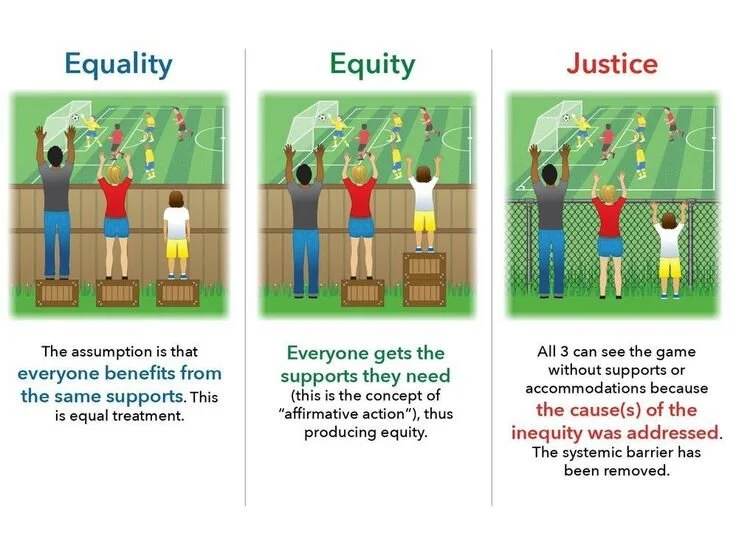
People tend to get this - it’s a good visual aid. But what happens when some people can’t see the fence for others because they don’t have one themselves? What happens when the blocked access is invisible because it is not their lived experience?
-
Do not wait to be tapped on the shoulder: Do not wait to be tapped on the shoulder in the hope your university will recognise your work. They are watching their budget, so will only wait for you to ask for recognition. They also make it hard once you do; seek help from those you trust.
Women of colour scholars are frequently unpaid: Women of colour scholars are frequently asked to pay for their own travel and accommodation when they are a keynote speaker, but funds are somehow found to cover the cost of the other white male keynote speakers. Protect and respect yourself.
Gaslighting: ‘Gaslighting’ is a term that has gained recent traction. It occurs when victims of social injustice question whether they really are victims. Your body will tell you by getting angry or sad (hopeful or hopeless for change). If you feel these things, there’s nothing more to question.
First authorship: No matter how young you are, if you did most of the work, make sure you are first author. You do not owe senior academics (especially males who benefit from a team of junior female researchers) later-order authorship just for the sake of honouring age-old norms not designed in your favour.
Everyone needs to check themselves: The neoliberalist system risks women turning on each other and their old shamed self, and human nature risks privileged men crying ‘me too’. Everyone needs to check themselves.
Allies of gender equity are unpredictable: Allies of gender equity are unpredictable; you will not know from gender or colour, for example, who they may be. Exercise caution, but allow yourself to be pleasantly surprised too.
Need help crafting the narrative around 'ROPE'? If you are applying for funding and need help crafting the narrative around research performance relative to opportunity (ROPE) consider contacting The GrantEd Group
Flexible work arrangements: Ask for flexible work arrangements such as working from home and at any time that suits you. There is no good reason why universities cannot accommodate this. Micro-managing intelligent intrinsically-driven adults is not one of them. Technology further enables it. Collegiality and ‘corridor conversations’ are possible without daily physical presence.
Double check manuscripts accepted for publication: Double check manuscripts accepted for publication. In-house copy editors have been known to edit or delete parts of titles, paragraphs, and punctuation intentionally selected without bringing it to the authors’ attention. Publications are a scholar’s creative artwork; words and thoughts, and the tempo they get put together, are their paint. Maintain final say. (Did Picasso let someone else touch up his work without asking? If that were to happen, he would probably never look at it again, failing to recognise it as his own, with all joy, pride, and satisfaction stolen). Make sure all suggested changes are in track - sometimes copy-editors have good ideas and catch things you have missed - but you are still the gate-keeper of your work.
If journals are rejecting your work, is it really about the quality of your paper? If journals are rejecting your work, ask yourself if it is really about the quality of your paper. Journals are vested in protecting their reputations, and their impact factors go down the more they publish women [5], so a study’s rigour, merit, or fit are not always enough. Pick who you work with (unfortunately only learned by trial, error, disappointment, disillusionment, and disrespect).
Excessive scrutiny of one’s work is workplace bullying: Excessive scrutiny of one’s work - bore more by women through higher rejection of it by journal editors and reviewers - is workplace bullying/harassment, but universities can slip free from their complicity with this psychological battering because it is not they who are doing it directly. Meet your publishing KPIs, and protect your mental health and intellectual freedom, by choosing not to publish in journal articles. Try books and book chapters instead.
-
Knowledge is power. Be careful who you give it to.
Sexism is rife and insidious throughout every aspect of academic life. Adjusting for it is not easy or quantifiable. It is not a simple paragraph when asked about ‘equity/diversity’ issues on a promotions application. Such questions are intrusive, can trigger trauma, and backfire - instead being used against them. This is because talk about dismantling gender stereotypes counter-productively affirms gender stereotypes. To avoid the trapped loop, silence is reverted back to. It becomes safer … Until a new tipping point shows up again. In the meantime, silence is mistakenly seen and stamped off as: ‘Issue addressed’.
Standardising assessment may help decision-making and bench-marking, and perceived transparency and fairness, but it actually penalises women increasingly as they deviate from the status quo. Its (unintended?) effect is ‘one size fits men’ [10]. The onus falls on women to prove why they don’t have the same access to opportunities as men. If we begin with that assumption - that the playing field is not level, as much as the erroneous ‘belief in a just world’ is hardwired into our cognition - then the onus can start to fall on men to prove why they have access to more. Women have busted the myth of gender blind/neutral meritocracy. It is only when management do too that things can change [11].
-
HR expect you to negotiate up, which is why they offer you the lowest possible contract level as their starting move. They will not offer you the level they think or know you are worth, and your insulted feelings are of no interest to them. It’s also very difficult to get promoted in academia. The carrot is kept intentionally out of reach, with minimal resources provided to help you reach it, all to keep costs low. Their decisions are business-driven only. Once you are boxed in by that low level, it’s amazing how much the whole world will also think that’s all you’re worth. The time to make the move is when the contract is first offered, not later. Women are usually so filled with gratitude and/or fear that they take the low terms without negotiating. If you have a life time of experience being undervalued, and so don’t know how to properly value yourself, here’s a rough guide to help you …
PhD NOT/YET AWARDED
Starting Level A: Relevant experience 1-3 years
1-3 years experience with junior teaching tasks (e.g. tutoring and/or marking) or senior teaching tasks (e.g. curriculum design, convening, lecturing) AND/OR
1-3 years experience with junior research tasks (e.g. locating relevant literature) or mid-level research tasks (e.g. literature reviews, data collection, data analysis, ethics application) OR
Honours or Masters completed, and/or 1-3 years relevant industry experience.
Starting Level B: Relevant experience 4-6 years
4-6 years experience with senior teaching tasks, at least one course per year AND/OR
4-6 years experience with senior research tasks (e.g. writing research proposals, grants, reports, articles, books; mentoring junior researchers, etc.) OR
Honours or Masters completed, and/or 4-6 years relevant industry experience.
Starting Level C: Relevant experience 7+ years
7+ years experience with senior teaching tasks, at least one course per year AND/OR
7+ years experience with senior research tasks OR
Honours or Masters completed, and/or 7+ years relevant industry experience.
PhD AWARDED
Starting Level B: Relevant experience 1-3 years
1-3 years experience with senior teaching tasks, at least one course per year AND/OR
1-3 years experience with senior research tasks.
Starting Level C: Relevant experience 4-9 years
4-9 years experience with senior teaching tasks, at least one course per year AND/OR
4-9 years experience with senior research tasks.
Starting Level D: Relevant experience 10+ years
10+ years experience with senior teaching tasks, at least one course per year AND/OR
10+ years experience with senior research tasks
You have expert knowledge in your field nationally, perhaps also internationally.
Starting Level E: Relevant experience 12+ years
12+ years experience with senior teaching tasks, at least one course per year AND/OR
12+ years experience with senior research tasks
You have expert knowledge in your field nationally and internationally
You would either like to take a high-level formal leadership role within the university (administration) or to informally act as a ‘Discipline Lead’ in your area of expertise within your School/Department or Faculty (thought leadership)
-
Don’t let women get too angry: Don’t let women get too angry. They pay with their likability (their most important but silencing/self-policing leverage), which sets them up to be accused of being at fault for their exploitation. Do an honest appraisal of how much free or cheap labour you are getting from them but turning a convenient blind eye to. In fact, these are direct dollars in the form of savings she is bringing to the university, and her real pay check may well be sitting in some senior manager’s bank account.
Make meeting times during school hours: Make meeting times during school hours. Provide digital means for women to attend if they cannot in person. Do not even implicitly vilify them if they cannot.
Look closely at your leadership profile: Look closely at your leadership profile. It may escape your attention that it is invariably white, but it doesn’t your staffs’.
See past the glare of metrics like the h-index: Big numbers are like shiny objects these days. See past the glare. Metrics like the h-index are more a measure of how many people the research topic is relevant to (e.g. cancer research vs the well-being of refugees). Pervasiveness is not a measure of importance.
Do not deny the intensity of labour of teaching: Do not underestimate or even deny the time- and emotion-intensive labour of teaching. Either bring back administrative staff responsible for the administrative components of teaching, or adjust teaching allocation models to more closely reflect the truth of what staff do.
Pedagogical outcomes are more important than how liked staff are: Course and teaching satisfaction scores are informative but should be used in balance with how well staff promote critical reflexivity. Pedagogical outcomes are more important than how liked staff are; easy when a subject is naturally interesting (e.g. psychology), not personally threatening (e.g. sociology), has a small class size, and delivered by the white male prototype of intelligentsia (long historically grown). Also ask students how transformational their learning was.
Ensure workload fits into a 37.5 hour week: A 40 : 40 : 20 profile means two days a week are dedicated to research and two to teaching. In the neoliberalist market of higher education, those two days of research have become the weekend and the two days of teaching are more like four. We are not all in this together, contrary to what management may like to think. Their unpaid overtime hours may be the same in number but the work they do has power, status, privilege, task diversity, a pay check, and self esteem that help take the sting off. Do not exploit staff who, with their academically trained and personal values for integrity and transparency, can take a long time to develop distrust and credulously believe in a system of merit-based fairness. The longer staff hold onto these false beliefs, the longer universities benefit. Streamline teaching expectations, and ensure workload fits into a 37.5 hour week.
Let everyone – women and men – talk about their families: Let everyone – women and men – talk about their families. Bygone but entrenched patriarchal norms of perceived unprofessionalism create silence, which fuel an illusion that space can be filled with more work. Do not underestimate how much men miss their children, but do not inflate or glorify their contribution to domestic affairs either.
Intellect and creativity are not replaceable: Time with families matters. Good sleep matters. Slowing down matters. Joy in one’s work matters. EQ matters. Intellect and creativity are not replaceable.
Do not underestimate the power of the word ‘sorry’: Do not underestimate the power of the word ‘sorry’. Women can get on with doing and loving their job if they hear an authentic one.
She also likes the sound of the word ‘thank you’: She also likes the sound of the word ‘thank you’. Make sure she has a mentor with an expansive not concrete mindset who says things like ‘I really like your idea’, ‘I trust you’, ‘What do you need to make that happen’, ‘Your idea didn’t work but I still like that you tried’. Words like ‘How come you haven’t done this yet’, ‘Why did you do it this way’, ‘Why haven’t you done more’, ‘Learn to work smarter not harder’ crush and alienate her even more. ‘If she’s not happy, she should just leave’ is also an absolution of organisational responsibility.
Assume all employees have more going on than you can know: Assume all employees have more going on in their lives than you can know. They may not want to tell, and you may not want to hear. Since academia is “not-for-profit” so does not reward performance with (non-confidential) bonuses, nor government so does not acknowledge overtime with accommodating rostered days off, simply sticking to workloads does right by them. ‘Flexible’ (i.e. always available) working arrangements, within unfair and difficult systems of career progression, are not a favour or carrot against exploitation.
The value of a thought cannot always be monetised: The value of a thought cannot always be monetised. Financial restructuring that supports this fact will help higher education bridge its crisis and dissonance in identity about whether it is or is not a business. Clear messaging about purpose and values, and aligned resource allocation, will clear confusion for staff who do not understand where they fit.
Expectations for performance cannot be the same when financial support has been zero for some: Expectations for performance cannot be the same across all staff when financial support for professional development (including sabbatical) has been zero for some and highly uneven across all.
Women want to be promoted at the right time: Women want to be promoted at the right time, for the work they have done and knowledge they bring, not when they have become long in the tooth. The reward otherwise becomes tainted.
-
Anger is both pain and hope; strong emotions without which change cannot occur - so working with anger is good. But working in anger will not achieve the long-term goal of gender equity with health. Compassion will. Brave universities will be respected. This service will start from the belief that good intentions are worth investing in. Your call for help, acknowledgment of your blind spots, and investment in your women, will be seen. Tokenism and lip-service are slow silent killers of spirit (or more).
“Angry women are free women” Mona Eltahawy
“Eloquent rage is not elegant rage. It is not pretty. It is precise. It names the problem clearly” Brittney Cooper
“When we speak we are afraid our words will not be heard or welcomed, but when we are silent we are still afraid, so it is better to speak” Audre Lorde
“Pain that is not transformed is transmitted” Brené Brown
"The worst thing you can do to another human being is make them feel they don't count" Roger Wilkins
-
It causes scholars - women and men - great consternation when they work to produce knowledge as a public good, not as a neoliberalised service to management.
Universities capitalise on your intrinsic motivation to deeply understand the world, and your extrinsic motivation to be rewarded for doing so. Academic staff in Australia donate approximately $1.4 billion per year in unpaid labour to their employers, working on average 50.7 hours per week but getting paid for 37.5 hours per week [6]. When promotions are handed out in sprinkles to those who are lucky, fit a mould, and/or have the ‘tailwind’ of structural support to reach the unrealistic expectations, the glasshouse of ‘meritocracy’ (that good work speaks for itself, so merit will be rewarded) will shatter for the most of us travelling in the ‘headwind’ - widening the abyss of lack of understanding between management and academic staff without which a university would not exist. The tailwind is behind them, so those travelling with its propelling force don’t often look back to see how it’s pushing them forward. The headwind is in front of them, so those travelling against it are forced to look it in the eye. The glasshouse is warm and comforting, but delusional and transparent. It’s assumed to be an objective equaliser. Unless you personally know otherwise, it can be nearly impossible to convince someone it’s not really there.
-
Research shows that workers are happier and more productive when their values align with their organisations’.
Yes or No - Under the ‘Service’ component of your promotions application, would you like to see a dedicated criterion to how you have enacted your personal and professional values, so they have a proper/non-tokenised chance to be acknowledged and rewarded? There’s many, but here’s just a few that might be important to you …
caring for the environment
modelling work-life balance
loving working with others and being part of a team
sharing recipes, mindfulness, and other joy-inspiring tips
honouring spontaneous creativity and intuition
modelling a ‘forever student’ mindset, and not pretending to know more than you do
starting from a place of empathy, consideration, and perceptiveness of the needs of others, and treating them with dignity
using humour, friendliness, and approachability to break barriers in the classroom and make content ‘stick’
saying sorry for harmful effects caused even without harmful intention
being gracious and brave by replying to uncomfortable emails and acknowledging the legitimate concerns of others
acting with courage, and protecting self-integrity, by speaking up about wrong-doing - either of your own or of others
deeply listening to others
being kind, compassionate, patient, collegial, trusting, and/or generous
being an analytical thinker, realistic, and/or a problem-solver
having a strong/hard work ethic, taking initiative, and/or being industrious
deeply engaging in critical reflexivity
paying attention to detail
being professional, mature, diplomatic, dependable, resourceful, organised, and/or punctual
being ethical and honest with yourself and others
being loyal, dedicated, passionate, humble, and/or enthusiastic
being a clear communicator
being supportive, encouraging, and inspiring
enacting allyship with those oppressed, silenced, and invisibilised by lower economic, social, cultural, and political power in genuine and on-going rather than performative ways
-
Given neoliberal academia’s business model depends on wage theft, in your opinion who is at fault for the stark inequality, injustice, and ill-health the higher education sector now perpetrates?
The government for withdrawing core funds in the first place and making universities act like businesses?
OR
Universities for fulfilling the expectation to act like a business so well?
-
Most criteria for promotion to Associate or Full Professor reflect the university’s value for money (e.g. external grants, PhD completions, etc.).
This means it doesn’t really matter how good your teaching, service, and research impact are - dollars talk more. If they can see that, it’s a nice simple decision for them. What you may have done or lost to make that happen is not of interest of them.
How much do your values align with theirs?
1: Not at all - The government needs to completely rethink its funding structure for higher education. Withdrawing core funds, and making funding conditional on highly competitive grants instead, has been detrimental to the equal rewarding of thought leadership across all disciplines. Intelligent staff now live in fear and expectations of gratitude they have a job and work in a high status industry, so agree to be kept busy and docile with repetitive, proceduralised, and closely monitored work that makes them too tired and scared to fight for proper access to the intellectual freedom that drew them to the sector in the first place.
2: Partially - Every business needs money and fiscal prudence and acumen to survive, but high profit margins are not what universities are meant to stand for. More profits should be reinvested into the core business of quality teaching and research, compared to investment in marketing, capital projects, and the salaries of senior management. Unexploitative workloads and equal professional development funds across all staff are also necessary to support this. Universities that equate quality with ethical critical inquiry, not satisfaction, are spending their money well. ‘Crying poor’ to requests for resources that support core business should not have become habitual/routine. No matter what, universities must not forget what they stand for in society - empirically rigorous and/or theoretically comprehensive intellectual independence from government and corporations.
3: Mostly/completely - The world has changed and we need to accept this. Folklore academics who speak of a time free of neoliberal managerialism are from a by-gone era and need to leave the sector. Their dissent is destabilising and unwelcome. As employees, we need to adapt in the same way universities have, and if the pursuit of money is now the most important thing, so be it - that’s what we’ve been employed to do. I also like knowing that if I meet this target, I will be rewarded with a well respected and well paying title. That’s worth the extra work.
-
It took me a year to prepare my draft application for promotion to Associate Professor, and did not receive in-principle support from two senior gatekeepers. One said “I can’t see what you’ve done since last promotion”, and the other said “It’s good to be bold but don’t you think you’re being too bold?” In finally accepting the entrenched racist sexism of academia that renders women of colour the cheapest of slaves with only 2% becoming Full Professors, I asked for a voluntary redundancy package at the end of 2020 when the Covid-19 pandemic hit and left academia after 20 years of dedicated service to the sector. I therefore did not submit a final/revised version. However, I did learn that there are many ways to showcase your professional worth and present the narrative of your achievements - hopefully the following list helps you find and convey the strength of your voice.
Find a spot somewhere in your application to use these self-promoting words - they love seeing them (and do feel good about what you’ve done too!):
Unique
Innovative
Forward thinking
Ahead of the curve
Impactful
Trail blazing
Ground breaking
Upward trajectory
Inspiring
Thought provoking
Influential
Invited
Seminal
Landmark
Passionate
Actively participated/contributed
High quality
High profile
High tiered
High value
Fostered/nurtured relationships for ongoing collaborations and funding
Thought leader/ship
Lucrative
Prestigious/competitive
Inter/nationally renowned/sought after
Consistently collegial and professional
Words that make you truly amazing but unlikely to be received well if they don’t translate to big dollars or threaten reputation:
Daring
Outspoken
Controversial
Rebellious
Committed to truth above all else
Honest
Ethical
Courageous
Caring
Considerate
Kind
Thoughtful
Friendly
Funny
Balanced and healthy with use of time
A real team-player (not a leach/loafer)
Money and reputation are the two most important things that universities in neoliberal academia care about, and they want you too as well at all cost. Until “reputation = uncomfortable boundary-pushing” the irony that “reputation = conformity” will evade what they can see.
-
Female-led papers are more likely to be rejected, male-led papers are more likely to be cited, men self-cite more often, and male-led research is perceived as of ‘higher scientific quality’
Reviews may be double blind, but editors can still see name and gender and reject papers before they can progress to peer-review
Men are twice as likely to be invited by journals to submit papers [5]
Women write about 45% of books in the US, but they are priced about 45% less than men’s [8]
Projects run by men get twice the budget and three times the people power [8]
Referrals to counselling services among university staff in the UK have increased between 123-424% since 2009, with women making up 70% of the referrals [9]
Elderly women are more likely to live in poverty: they have less access to household finances, and the global gender pay gap is 38% [10]
White women earn 70 cents to the white man’s dollar, and women of colour earn 30-50 cents depending on what type ‘of colour’ they are [10]
The lifetime wage gap between a white man and woman of colour in the US is nearly $2m before any of it has been invested [18]
Men objectively do less of the housework, but around 60% in western countries subjectively think they do “their fair share” [12]
Globally, 75% of unpaid work is done by women; an average of 3 to 6 hours per day, compared to men doing between 30 minutes and 2 hours per day [10]
If women’s care-giving labour were included, it would make up somewhere between 30-50% of reported GDP [8]
Working 60 hours of paid work per week for 30 years, triples the risk of women developing life-threatening diseases such as heart disease and cancer [10]
Women report their highest levels of life satisfaction only late in life, after their caring responsibilities have finally eased [13]
Toxic femininity grows a gentle flower it then cuts down. She will grow back; a thorn in place of each cut. The scent is of liberation. Her roots will search for safety, joy, and connection.
-
This list was not intended to be exhaustive, but if you would like your work added to it please contact me. It was created in 2020 and has not been updated since.
The literature is a long and growing list. The one here is not exhaustive, and for every one that manages to get published in a scholarly outlet, who knows how many have had to find a less ‘valid’ home, or are not being spoken at all. Anecdotally, as I searched for this relevant research I noticed that for several articles ‘number of reads’ were in their thousands but ‘number of citations’ were less than 100. People are really interested in this topic, and lots of women have lots to say about it (and some men - thank you). But what’s with the gap?
Cited articles
[1] Crimmins, G. (2019). Strategies for resisting sexism in the academy: Higher education, gender and intersectionality. Palgrave Macmillan: Australia.
[2] Clark, L. (1977). Fact and fantasy: A recent profile of women in academia. Peabody Journal of Education, 54(2), 103–109.
[3] Savigny, H. (2014). Women, know your limits: Cultural sexism in academia. Gender and Education, 26(7), 794–809.
[4] Griffin, R. A. (2016). Black female faculty, resilient grit, and determined grace or “just because everything is different doesn’t mean anything has changed”. The Journal of Negro Education, 85(3), 365–379.
[5] Holman, L., Stuart-Fox, D., Hauser, C. E. (2018). The gender gap in science: How long until women are equally represented? PLoS Biology, 16(4): e2004956.
[6] Sims, M. (2020). Bullshit towers: Neoliberalism and managerialism in universities in Australia. Peter Lang: Oxford, UK.
[7] Peterson, H. (2015). “Unfair to women”? Equal representation policies in Swedish academia. Equality, Diversity and Inclusion: An International Journal, 34(1), 55–66.
[8] Chemaly, S. (2018). Rage becomes her: The power of women’s anger. Simon & Schuster: US.
[9] Morrish, L. (2019). Pressure vessels: The epidemic of poor mental health among higher education staff. Oxford: UK.
[10] Perez, C. C. (2019). Invisible women: Exposing data bias in a world designed for men. Chatto & Windus: UK.
[11] Nielsen, M. W. (2016). Limits to meritocracy? Gender in academic recruitment and promotion processes. Science and Public Policy, 43(3), 386-399.
[12] Craig, L. & Sawrikar, P. (2007). Housework and divorce: the division of domestic labour and relationship breakdown in Australia. Refereed paper for HILDA Conference, Melbourne, July.
[13] Rauch, J. (2018). The happiness curve: Why life gets better after midlife. Green Tree: UK.
[14] Baker, M. (2012). Gendered families, academic work and the ‘motherhood penalty’. Women’s Studies Journal, 26(1), 11–24.
[15] Husu, L. (2001). On metaphors on the position of women in academia and science. Nora: Nordic Journal of Women's Studies, 9(3), 172–181.
[16] Husu, L. (2005). Women’s work-related and family-related discrimination and support in academia. Gender realities: local and global. Advances in Gender Research, 9, 161–199.
[17] Deo, M. E. (2015). The ugly truth about legal academia. Brooklyn Law Review, 80(3), 943–1014.
[18] The State of the Gender Pay Gap in 2021. payscale.com
————————
A postdoc who persisted. (2017). Academia needs to confront sexism. Science, 357(6347), 222.
Ahmed, S. (2017). Living a feminist life. Duke University Press: UK.
Antecol, H., Bedard, K., & Stearns, J. (2018). Equal but inequitable: Who benefits from gender-neutral tenure clock stopping policies? American Economic Review, 108(9), 2420–2441.
Asmar, C. (1999). Is there a gendered agenda in academia? The research experience of female and male PhD graduates in Australian universities. Higher Education, 38(3), 255–273.
Azman, N., Omar, I. C., Yunus, A. S. M., & Zain, A. N. M. (2016). Academic promotion in Malaysian public universities: A critical look at issues and challenges. Oxford Review of Education, 42(1), 71–88.
Bagues, M., Sylos-Labini, M., & Zinovyeva, N. (2017). Does the gender composition of scientific committees matter? American Economic Review, 107(4), 1207–1238.
Baker, M. (2016). Women graduates and the workplace: Continuing challenges for academic women. Studies in Higher Education, 41(5), 887–900.
B. A. L. (2019). The hidden costs of serving our community: Women faculty of color, racist sexism, and false security in a Hispanic-serving institution. Feminist Teacher, 27(2–3), 176–195.
Barlow, C. & Awan, I. (2016). “You need to be sorted out with a knife”: The attempted online silencing of women and people of Muslim faith within academia. Social Media and Society, 1–11.
Bernal, D. D. & Villalpando, O. (2002). An apartheid of knowledge in academia: The struggle over the “legitimate” knowledge of faculty of color. Equity and Excellence in Education, 35(2), 169–180.
Bevan, V. & Learmonth, M. (2012). ‘I wouldn’t say it’s sexism, except that … It’s all these little subtle things’: Healthcare scientists’ accounts of gender in healthcare science laboratories. Social Studies of Science, 43(1), 136–158.
Biggs, J., Hawley, P. H., & Biernat, M. (2018). The academic conference as a chilly climate for women: Effects of gender representation on experiences of sexism, coping, responses, and career intentions. Sex Roles, 78, 394–408.
Bosquet, C., Combes, P-P., Garcıa-Penalosa, C. (2019). Gender and promotions: Evidence from academic economists in France. The Scandinavian Journal of Economics, 121(3), 1020–1053.
Britton, D. M. (2017). Beyond the chilly climate: The salience of gender in women’s academic careers. Gender and Society, 31(1), 5–27.
Brabazon, T. & Schulz, S. (2018). Braving the bull: Women, mentoring, and leadership in higher education. Gender and Education, 1–18. doi:10.1080/09540253.2018.1544362
Bronstein, P. (2001). Older women in academia: Contemporary history and issues. Journal of Women’s History, 12(4), 184–201.
Calafell, B. M. (2012). Monstrous femininity: Constructions of women of color in the academy. Journal of Communication Inquiry, 36(2), 111–130.
Carr, P. L., Gunn, C., Raj, A., Kaplan, S., & Freund, K. M. (2107). Recruitment, promotion, and retention of women in academic medicine: How institutions are addressing gender disparities. Women’s Health Issues, 27(3), 374–381.
Chambers, C. R. (2011–2012). Candid reflections on the departure of black women faculty from academe in the United States. The Negro Educational Review, 62 & 63(1–4), 233–265.
Coate, K. & Howson, C. K. (2016). Indicators of esteem: Gender and prestige in academic work. British Journal of Sociology of Education, 37(4), 567–585.
Cohoon, J. M., Wu, Z., & Chao, J. (2009). Sexism: Toxic to women’s persistence in CSE doctoral programs. SIGCSE, 3–7, 158–162.
Cortina, L. M., Swan, S., Fitzgerald, L. F., & Waldo, C. (1998). Sexual harassment and assault: Chilling the climate for women in academia. Psychology of Women Quarterly, 22, 419–441.
Crabtree, S. A. & Shiel, C. (2019). “Playing mother”: Channeled careers and the construction of gender in academia. SAGE Open, 1–14.
Croom, N. N. (2017). Promotion beyond tenure: Unpacking racism and sexism in the experiences of black womyn professors. The Review of Higher Education, 40(4), 557–583.
Cundiff, J. L., Danube, C. L., Zawadzki, M. J., & Shields, S. A. (2018). Testing an intervention for recognizing and reporting subtle gender bias in promotion and tenure decisions. The Journal of Higher Education, 89(5), 611–636.
Dar, S., Liu, H., Dy, A. M., & Brewis, D. N. (2020). The business school is racist: Act up! Organization, 1–12.
de Madariaga, I. S. (2010) Women in architecture: The Spanish case. Urban Research and Practice, 3(2), 203–218.
De Paola, M., Ponzo, M., & Scoppa, V. (2017). Gender differences in the propensity to apply for promotion: Evidence from the Italian Scientific Qualification. Oxford Economic Papers, 69(4), 986–1009.
Duncan, P. (2014). Hot commodities, cheap labor: Women of color in the academy. Frontiers, 35(3), 39–63.
Edwards, R. (2020). Why do academics do unfunded research? Resistance, compliance and identity in the UK neoliberal university. Studies in Higher Education, 1-11.
Eliason. K., Hall, M. E. L., & Anderson, T. L. (2012). Because God said so: Religious facets of sexual and gender harassment in Christian academia. Journal of Psychology and Theology, 40(1), 345–355.
Falkner, K., Szabo, C., Michell, D., Szorenyi, A., & Thyer, S. (2015). Gender gap in academia: Perceptions of female computer science academics. ITICSE, 4–8, 111–116.
Frank, M. C. (2019). N-best evaluation for academic hiring and promotion. Trends in Cognitive Sciences, 23(12), 983–986.
Fotaki, M. (2013). No woman is like a man (in academia): The masculine symbolic order and the unwanted female body. Organization Studies, 34(9), 1251–1275.
Freidenreich, H. P. (2007). Joining the faculty club: Jewish women academics in the United States. Nashim: A Journal of Jewish Women's Studies and Gender Issues, 13, 68–101.
Fujiwara, A. (2018). When can academic researchers rest? An event history analysis on researchers’ research productivity and promotion in academia from 1980 to 2016 in Japan. Open Review of Educational Research, 5(1), 130–143.
Gill, R. (2011). Sexism reloaded, or, it’s time to get angry again! Feminist Media Studies, 11(1), 61–71.
Gray, E., Knight, L., Blaise, M. (2018). Wearing, speaking and shouting about sexism: Developing arts-based interventions into sexism in the academy. Australian Education and Research, 45, 585–601.
Guarino, C. M. & Borden, V. M. H. (2017). Faculty service loads and gender: Are women taking care of the academic family? Research in Higher Education, 58, 672–694.
Hall, M. E. L., Christerson, B., & Cunningham, S. (2010). Sanctified sexism: Religious beliefs and the gender harassment of academic women. Psychology of Women Quarterly, 34, 181–185.
Heineman, J. (2019). Surviving academia and performing sex work: A look at labour under neoliberalism. Dollars and Sense, 15–19.
Howe-Walsh, L. & Turnbull, S. (2016). Barriers to women leaders in academia: Tales from science and technology. Studies in Higher Education, 41(3), 415–428.
Hughes, C. C., Schilt, K., Gorman, B. K., & Bratter, J. L. (2017). Framing the faculty gender gap: A view from STEM doctoral students. Gender, Work and Organization, 24(4), 398–416.
Kauffman, D. R. & Perry, F. J. (1989). Institutionalized sexism in universities: The case of geographically bound academic women. NWSA Journal, 1(4), 644–659.
Kim, C. L., Anderson, T. L., Hall, M. E L., & Willingham, M. W. (2010). Asian and female in the white God’s world: A qualitative exploration of discrimination in Christian academia. Mental Health, Religion and Culture, 13(5), 453–465.
King, E. B. (2008). The effect of bias on the advancement of working mothers: Disentangling legitimate concerns from inaccurate stereotypes as predictors of advancement in academe. Human Relations, 61(12), 1677–1711.
Knights, D. & Richards, W. (200). Sex discrimination in UK academia. Gender, Work and Organization, 10(2), 213–238.
Lee, J. J. (2013). Six women scientists who were snubbed due to sexism. National Geographic.
Leaper, C. & Arias, D. M. (2011). College women’s feminist identity: A multidimensional analysis with implications for coping with sexism. Sex Roles, 64, 475–490.
Liu, H. (2019). An embarrassment of riches: The seduction of postfeminism in the academy. Organization, 26(1), 20–37.
Lohela-Karlsson, M., Nybergh, L., & Jensen, I. (2018). Perceived health and work-environment related problems and associated subjective production loss in an academic population. BMC Public Health, 18, 257.
López, T. A. (2006). Speaking frankly, documenting struggle: Chicanas/Latinas in academia. Chicana/Latina studies, 6(1), 132–136.
Macoun, A. & Miller, D. (2014). Surviving (thriving) in academia: Feminist support networks and women ECRs. Journal of Gender Studies, 23(3), 287–301.
Mayer, A. L. & Tikka, P. M. (2008). Family-friendly policies and gender bias in academia. Journal of Higher Education Policy and Management, 30(4), 363–374.
Mallery, T. A., Mittman, I. S., Castillo-Page, L., Eliason, J., & Navarro, R. C. (2019). A stochastic model of consensus reaching in committee decisions for faculty advancement, promotion and tenure: Does diversity matter? Journal of the National Medical Association, 111(4), 418–426.
Martinez, M. A., Chang, A., & Welton, A. D. (2017). Assistant professors of color confront the inequitable terrain of academia: A community cultural wealth perspective. Race, Ethnicity and Education, 20(5), 696–710.
McCook, A. (2013). Barred from the boardroom. Nature, 495, 25–27.
McKiernan, E. C., Schimanski, L. A., Nieves, C. M., Matthias, L., Niles, M. Y., & Alperin, J. P. (2019). Use of the journal impact factor in academic review, promotion, and tenure evaluations. eLife, 8:e47338.
McGee, E. O. & Bentley, L. (2017). The troubled success of black women in STEM. Cognition and Instruction, 35(4), 265–289.
Mehta, S., Rose, L., Cook, D., Herridge, M., Owais, S., & Metaxa, V. (2018). The speaker gender gap at critical care conferences. Critical Care Medicine, 46, 991–996.
Metz, I., Harzing, A-W., & Zyphur, M. J. (2016). Of journal editors and editorial boards: Who are the trailblazers in increasing editorial board gender equality? British Journal of Management, 27, 712–726.
Millar, P. & Barker, J. E. (2020). Gender and academic promotion to full professor in Ontario. Canadian Journal of Sociology, 45(1), 47-69.
Morello, L. (2015). We can # it. Nature, 527, 148–151.
Mueller, C., Wright, R., & Girod, S. (2017). The publication gender gap in US academic surgery. BMC Surgery, 17, 16.
Nash, M., Nielsen, H. E. F., Shaw, J., King, M., Lea, M., & Bax, N. (2019). “Antarctica just has this hero factor...”: Gendered barriers to Australian Antarctic research and remote fieldwork. PLoS ONE, 14(1).
Navarro, T. (2017). But some of us are broke: Race, gender, and the neoliberalization of the academy. American Anthropologist, 119(3), 506–517.
Nielsen, M. W. (2016). Limits to meritocracy? Gender in academic recruitment and promotion processes. Science and Public Policy, 43(3), 386–399.
Ovseiko, P. V., Chapple, A., Edmunds, L. D. & Ziebland, S. (2017). Advancing gender equality through the Athena SWAN Charter for Women in Science: An exploratory study of women’s and men’s perceptions. Health Research Policy and Systems, 15:12.
Palepu, A. & Herbert, C. A. (2002). Medical women in academia: The silences we keep. Canadian Medical Association Journal, 167(8), 877–879.
Parker, P., Hewitt, B., Witheriff, J., & Frank, A. C. (2018). Frank and fearless: Supporting academic career progression for women in an Australian program. Administrative Sciences, 8, 5.
Patton, T. O. (2004). Reflections of a black woman professor: Racism and sexism in academia. Howard Journal of Communications, 15(3), 185–200.
Perger, N. (2016). Sexism: naming a problem, becoming a problem. Teorija In Praksa, 53(6), 1386–1400.
Phipps, A. (2017). (Re)theorising laddish masculinities in higher education. Gender and Education, 29(7), 815–830.
Rahman, F. (2018). The merits and limits of a gendered epistemology: Muslim women and the politics of knowledge production. Journal of International Women’s Studies, 19(1).
Ren, X. & Caudle, D. J. (2020). Balancing academia and family life: The gendered strains and struggles between the UK and China compared. Gender in Management: An International Journal, 35(2), 141–165.
Riley, S., Frith, H., Archer, L., & Veseley, L. (2006). Institutional sexism in academia. The Psychologist, 19(2), 94–97.
Rivera, L. A. (2017). When two bodies are (not) a problem: Gender and relationship status discrimination in academic hiring. American Sociological Review, 82(6), 1111–1138.
Rollero, C. & Fedi, A. (2014). When benevolence harms women and favours men: The effects of ambivalent sexism on leadership aspiration. Ceskoslovenska Psychologie, 58(6), 535–542.
Salazar, C. F. (2009). Strategies to survive and thrive in academia: The collective voices of counseling faculty of colour. International Journal of Advanced Counselling, 31, 181–198.
Samuel, E. & Wane, N. (2005). “Unsettling relations”: Racism and sexism experienced by faculty of color in a predominantly white Canadian university. The Journal of Negro Education, 74(1), 76–87.
Savigny, H. (2019). Cultural sexism and the UK Higher Education sector. Journal of Gender Studies, 28(6), 661–673.
Savigny, H. (2017). Cultural sexism is ordinary: Writing and re-writing women in academia. Gender, Work and Organization, 24(6), 643–655.
Schimanski, L. A. & Alperin, J. P. (2019). The evaluation of scholarship in academic promotion and tenure processes: Past, present, and future. F1000Research, 7, 1605.
Schneider, B. Z., Carden, W., Francisco, A., & Jones Jr., T. O. (2009). Women ‘opting out’ of academia: At what cost? Forum on Public Policy, 1–19.
Silander, C., Haake, U., & Lindberg, L. (2013). The different worlds of academia: A horizontal analysis of gender equality in Swedish higher education. Higher Education, 66(2), 173–188.
Silverschanz, P., Cortina, L. M., Konik, J., & Magley, V. J. (2008). Slurs, snubs, and queer jokes: Incidence and impact of heterosexist harassment in academia. Sex Roles, 58, 179–191.
Smith, K. N. & Gayles, J. G. (2018). “Girl power”: Gendered academic and workplace experiences of college women in engineering. Social Sciences, 7, 11.
Sotello, C. & Turner, V. (2002). Women of color in academe: Living with multiple marginality. The Journal of Higher Education, 73(1), 74–93.
Stanley, C. A. (2007). When counter narratives meet master narratives in the journal editorial-review process. Educational Researcher, 36(1), 14–24.
Subbaye, R. (2017). The shrinking professoriate: Academic promotion and university teaching. South African Journal of Higher Education, 31(3), 249‒273.
Takahashi, A M., Takahashi S., & Ueda, A. (2019). Gender promotion gap in Japanese academia in 2004–2013: Has it changed over time? Graduate School of Economics, Kobe University, Discussion Paper No. 1914.
Tenbrunsel, A. E., Rees, M. R., & Diekmann, K. A. (2019). Sexual harassment in academia: Ethical climates and bounded ethicality. Annual Review of Psychology, 70, 245–270.
Todd, Z., Madill, A., Shaw, N., & Brown, N. (2008). Faculty members’ perceptions of how academic work is evaluated: Similarities and differences by gender. Sex Roles, 59, 765–775.
Toffoletti, K. & Starr, K. (2016). Women academics and work–life balance: Gendered discourses of work and care. Gender, Work and Organization, 23(5), 489–504.
Trujillo‑Pagan, N. (2018). Crossed out by LatinX: Gender neutrality and genderblind sexism. Latina Studies, 16, 396–406.
Tsouroufli, M. (2018). ‘Playing it right?’: Gendered performances of professional respectability and 'authenticity’ in Greek academia. Journal of International Women’s Studies, 19(6).
Valian, V. (2005). Beyond gender schemas: Improving the advancement of women in academia. Hypatia, 20(3), 198–213.
van den Brink, M. & Benschop, Y. (2012). Slaying the seven-headed dragon: The quest for gender change in academia. Gender, Work and Organization, 19(1), 71–92.
Weisshaar, K. (2017). Publish and perish? An assessment of gender gaps in promotion to tenure in academia. Social Forces, 96(2), 529–560.
Williams, J. C. (2005). The glass ceiling and the maternal wall in academia. New Directions For Higher Education, 130, 91–105.
Winslow, S. & Davis, S. N. (2016). Gender inequality across the academic life course. Sociology Compass, 10(5), 404–416.
Zeligman, M., Prescod, D. J., & Greene, J. H. (2015). Journey toward becoming a counselor education doctoral student: Perspectives of women of color. The Journal of Negro Education, 84(1), 66–79.
Zhao, J. & Jones, K. (2017). Women and leadership in higher education in China: Discourse and the discursive construction of identity. Administrative Science, 7, 21.
-
Don’t just want to fix the system we’ve got by adjusting for unequal access one woman at a time (equity), but change it completely once and for all to make access equal no matter who you are (justice)? Read on
An extract.
Sawrikar, P. (2020). Proposing a feminist funding model for academia while coping with the financial impact of Covid-19: A thought piece from Australia. DOI: 10.13140/RG.2.2.32391.21924
“Transforming the entire system to be gender-sensitive and -aware is a kind and fair reward system, in which the withdrawal of government funds has not become her direct problem to fix.
In the new system, any form of funding she is able to attract, and any type of pedagogy she implements or research she conducts, is not subject to elitism. This elitism is gendered; women are associated with the work that is less valued. Pretending this fact away, and then expecting women to strive for and be able to equally attain the more valued goals sets her up for both failure and ill-health.
Heart disease is the leading cause of death among women 65 years and over, but is underestimated, less well understood, less frequently diagnosed, and receives less patient care and national awareness-raising attention due to universalist assumptions and therefore the historical exclusion of women from clinical trials. Its risk reflects in part the accumulation of trauma and stress across the lifespan, including that globally 75% of care-giving labour is done, unpaid, by women. It makes work goals already unreachable within the annual work allocation model even more so.
More dangerously, it pits investment in and protection of institutional reputation against creativity and innovation, which in turn depend on diversity. It leads to conservative, fear-informed, politically-pleasing mindedness; the very opposite of what academia is naively believed by the public to stand for. Universities’ insidious need to depend on the government for substantial funding to survive, means it is forced to direct its business toward endeavours the government would be willing to fund.
Self-silencing through fear is a form of psychological abuse and financial control and exploitation. Staff from all backgrounds (humble white men included) have been known to describe working in universities as a traumatic experience, and some have likened it to being in a domestic violence relationship. She does not ‘just leave’ because the alternative – poverty and/or homelessness – is worse. She stays with the devil she knows, and remains quiet about the abuse she tolerates. If a university wants to have and be known for having an ambitious research agenda, it needs to seriously ask itself why, because that depends on further exploitation of staff. Is that what they are willing and willingly doing?”
-
Making sense of patterns
Scientists - truth chasers - know they need to keep an eye on the data that confirms the pattern as well as the data that doesn’t. This service is designed to address the toxic obstacle course women run in trying to receive recognition for their service to the industry across their whole lives. But I am all ears if because of your gender…
RESEARCH
your research proposal has been overlooked for support by your university
initial support for your research ambitions/projects have later been withdrawn
you have found it hard to attract PhD students to supervise, or early career and established researchers to collaborate with
you have been lumped with teaching or administrative loads that limit research opportunity, and find it hard to say no to them
you can’t understand how ‘big women on campus’ escape heavy teaching loads, secretly think they would be bad teachers anyway, and wonder if you would be rewarded for your bad teaching with more research opportunity
your Head of Department always sends emails celebrating the success of women recipients of research grants but has sometimes missed yours and other men you work with
you have seen your Head of Department give preferential treatment to women including in informal intellectual conversations, introductions to like-minded others of influence, and investment in research skill development
the ‘research’ component of all staff on ‘teaching focused’ work profiles was changed to ‘scholarship of learning and teaching’ without consultation with individuals about their research interests and ambitions, to reduce the number of staff in the department who might otherwise appear not ‘research active’
your work has been overly scrutinised compared to the work of female colleagues, or its validity questioned because of perceptions it is not empirically rigorous
your academic wife has prestige and seniority in your academic collaborations
you have had ‘good enough’/publishable articles repeatedly rejected, for reasons that sound more like a line (e.g. “it is outside the journal’s scope” when it’s clearly not)
you often have to remind conference organisers to invite at least some male keynote speakers
you have experienced serious delays in the execution of contracts and therefore payment for services or royalties for no real good reason
you have found it hard to get funding for conferences or other networking and professional development opportunities
you are self-funding more parts of your job than you have received funding support from your university for, and which you cannot afford to meet your work milestones/expectations
you know of women colleagues whose applications for sabbatical have been approved or even multiple times, yet yours has not been approved once despite being eligible and/or overdue
your economic benefit to the university, through international networking that enhances research grant success, was not prioritised in your application for sabbatical due to the disruption it would cause to caring responsibilities, so was not approved
you partly sole publish due to low opportunity to collaborate or because of scholarly alienation, but are then criticised as being too independent, with concerns raised about your ability to work as part of a team
you find rejections of your articles hard because they confirm your ‘imposter syndrome’
you have thought about using a less masculine more androgynous or feminine version of your name to increase chances of getting published
your PhD supervisor kept recommending women scholars to read and cite
you work in a ‘hostile climate’ resistant to hearing and respecting your knowledge, or are presumed incompetent and have to prove otherwise over and over, not just to journal editors, PhD supervisors, and other seniors but students too, and see the opposite patterns for women you work with
TEACHING
you notice that whenever staff go on leave, their teaching load typically goes to men
your university has a pattern of giving courses with high student enrolments to the new male staff - naïve, and eager to please and make a good first impression - but women just starting the job tend to be eased into high student loads
your impression is that the cyberbullying of staff by students on anonymous evaluation surveys is worse for men than women
you provide pastoral care for students and support to colleagues that goes unrecognised in work allocation models, and feel emotionally drained by your work
your teaching evaluation scores are considered ‘true data’, compared to the positive qualitative comments received
you notice that students often drop by your and other’s men’s doors for a chat or advice, but not so much the women you work with; while affirming of their trust in you, you feel pressured to work with an ‘open door policy’ which interrupts your ‘writing flow’
students come to you more often than women colleagues with serious problems like domestic violence, sexual assault, miscarriage, poverty, racism, threat of homelessness, homophobic discrimination, etc.
you feel deskilled by the repetitive nature of teaching and marking, and denied ‘a seat at the table’ to more interesting opportunities
students have made hurtful comments or other “micro” aggressions to your face, in emails, or in anonymous evaluation surveys aimed to ‘put you back in your place’
you teach subjects within disciplines that are gendered, and therefore likely to be controversial or divisive, so struggle to attract teaching and course evaluation scores that reflect your hard work, care and effort, practice wisdom and lived experience, high quality teaching materials, and promotion of pedagogy
your perceived credibility and authority are publicly challenged, such as requests for re-grading assessments in front of other students
PROMOTION AND PAY
you are a workhorse, but regularly see women climb the ranks with greater ease having done less
you feel sheepish asking for advice about predatory journals or conferences in case it affirms perceptions you will always need a senior mentor
you feel uncomfortable being asked who you mentor because you treat everyone as an intellectual equal and trust they do good work given they have passed the rigours of a PhD program
you feel that no matter how excellent your track record of achievements are, there’s always ‘something’ you could or should have done better; if you get too close to the carrot, the carrot moves
you regularly see women get promoted for ‘talking the talk’, but they don’t really have the goods to back it up
you are often advised to just be selfish or act like a woman if you want to get promoted, and part-envy part-resent the power, status, privilege, funding, influence, rewards, and opportunities that come with higher academic titles
you find the process of applying for promotion harrowing
you speak modestly about your achievements
you have shaky professional confidence because of your long history of being ignored, discouraged, or discounted
you avoid senior positions because of friendships you might lose
you see women apply for promotion when they only meet half the criteria, but their confidence in their abilities gets them the promotion
you avoid promotion so that others don’t see you as scheming, ruthless, or ‘an honorary woman’ [14]
you are so put off by how hard it was to be recognised for Senior Lecturer or Associate Professor that you have already decided not to bother going any further; with long thought-through bitter sweetness, selling yourself short has become the better option for your overall personal health
you rarely receive external job offers compared to women you hear about, but are uncomfortable with using it as a career-enhancing tactic and do not have geographic mobility due to caring anyway
you have accepted career demotions while relocating to support your wife’s career progression, and have accepted the first offer of employment you could get and not bargained for a higher salary or rank
(excluding those strategically given to meet target quotas) you have seen opportunities such as appointments or promotions go to women when you just knew you were better placed to get them because of your knowledge and expertise
you are all too familiar with metaphors like ‘chilly climate’, ‘leaky pipeline’, ‘glass ceilings’, ‘sticky floors’, ‘storming the tower’, ‘ivory basement’, ‘Mathew/Matilda effect’, and ‘black hole’ [15]
you were informally acknowledged of your worth but told that due to rules about how the job was advertised you can only be offered the top step of a lower level, and was assured promotion to the correct level would be quick
you have become aware of a woman colleague offered a non-transparent loading for temporarily taking on higher roles or duties despite having more qualifications and experience than her
you have not moved academic levels for years, sometimes decades, at a time
your parents don’t support your career progression as much as your sisters’
you feel your workplace assumes you are not the or equal breadwinner of your household
your position is financially insecure
the catch cry ‘same work, same pay’ resonates with you
you have been paid less than a woman colleague you know despite having similar qualifications and experience
women you work with regularly name drop people with power they know or prestigious institutions they worked at previously to credentialise themselves, but you prefer to let the merit of your work speak for itself
you have felt like the token ‘affirmative action hire’, so work really hard to prove your equal worth
WORK-LIFE BALANCE
you started your PhD later so you could have a family first, and the ‘tenure clock vs biological clock’ is pertinent to decision making in your life
you choose to write articles rather than books because they are shorter, so you can more easily manage work time with juggling caring
you have taken part-time work until you felt confident you could manage caring and full-time work, or teaching-focused work to relieve pressure to publish while caring
you see being physically present part of being ‘a good father’, and have felt vilified for not being able to attend meetings due to caring responsibilities
you wake up very early or work late into the night to catch some quiet time around child-rearing responsibilities during the day
you are time-poor, time-stressed, time-interrupted, and have father’s guilt due to juggling work and work commutes with school pickups and dropoffs, the extracurricular activities, homework, medical appointments, and play dates of children, maintenance of relationships with teachers and other parents, and housework and meal preparation for the family; 'trip-chaining’ [10]
your unpaid ‘second shift’ of attending to domestic affairs goes mostly unrecognised by your partner and your workplace
you were scared you might lose your job or be demoted after returning from paternity leave because of misperceptions you were less competent or committed than women
compared to women professors you know, more men professors are divorced and are the primary carer of children as a single parent
you regularly type with one hand as you nurse a sick child or bottle feed them with the other
you have felt uncomfortably glorified for being ‘efficient’ at managing caring and working, when you are actually just treading water
you have lost time for leisure and health to the juggle of work and care, and you feel powerless to change the division of domestic labour in which you always do the lion’s share of housework, childcare, and care for elderly parents
you think about, organise, allocate, take responsibility for, and do more of the housework to avoid marital conflict, or because you cannot afford to hire domestic help
you don’t have access to a full time stay-at-home partner that supports your career like other men colleagues you know
your university’s academic calendar does not line up with school holidays, which makes it hard for you and mature age students with children; sometimes children are in your class because there’s no other choice but the content is age-inappropriate
when you brought your child to class because you had no other choice you were seen as unprofessional (you got a look from your manager, but students said it explicitly in their evaluations), but when other women have done it they are seen as ‘caring juggling heroes’
you love your children but they’ve killed your career while being a boon to your wife’s; she earns even more money than her female childless colleagues
you sometimes get down about all the potential your employer could not see in you, the years of potential you feel you have lost to being the ‘selfless man’ society expects of you, and the years you know you cannot get back
you feel that having children has taken your personal identity from you, that your family claims your time and mental space with boundaries that are difficult and tiring to enforce, and that your ambitions for work aren’t really seen as having value so time is not carved out by your workplace to help you pursue them
you are accused of wanting it all – work and family – but resent the expectation to choose since women don’t have to
SAFETY
senior women colleagues have petted “your beautiful hair” or commented on your physique, as if it’s a harmless compliment with no impact on your personal space or professional credibility
you have experienced trolling, hate speech, threats of sexual violence and ‘corrective rape’, or death threats, in response to articles you have published on social media
you have felt unsafe on campus, received unwanted sexual attention, or been sexually harassed in other ways at work
the claims of your male colleague of being sexually assaulted by a senior woman academic have been hushed up because she brings in a lot of money to the university
SERVICE
gains in progressing equity/diversity issues feel marginal compared to the time you burn up being a member of such a committee
the administrative staff in your department seem to prioritise the concerns of women academics over mens’
you work with many women who think they are above administrative/support jobs so leave it to men to do
you have been introduced without your title at a time it is professionally appropriate (e.g. as keynote speaker)
you feel held back by stereotypes about what men are presumed to be naturally good at (e.g. computer science vs social work)
your manager is a stickler for time for your meetings, but relaxed when meeting with women should they be late or go overtime
you are often asked to be the note-taker or tea-maker at meetings where all parties have equal professional standing
you are routinely interrupted by a woman while making a contribution to the team, or have your contributions paraphrased or credit for them taken by a woman colleague
you find yourself apologising or thanking people a lot, and your emails are full of exclamation marks or other punctuation that help them appear friendly
you have few male managerial role models to look up to, and female managers value the opinions of other women more in their decision-making
you have had to stop and re-direct laboratory work because your female manager had a new idea or one she thought was better than yours
you are glorified for having ‘focus’ as a way of being assigned disproportionate low-status low-paying microscope support/technician work
you and other men you work with are routinely called ‘boys’ rather than men
you have felt unheard, unseen, devalued, dismissed, unappreciated, used, exploited, not paid attention to, overlooked, unvalidated, uninvited, unpraised, or unwelcome
your discrimination can be hard to describe, often in the form of ‘non-events’ such as silences, omissions, absences, subtle exclusions, ignoring, invisibility, lack of support, and lack of encouragement [16]
you have been made to feel ‘too young’, ‘too old’, ‘too large’, ‘too handsome’, ‘not handsome enough’, ‘too serious’, ‘not serious enough’, ‘overdressed’, or ‘underdressed’
you have struggled to develop a sense of belonging to/community with your department, university, or academia, because you like to work as part of a team but the organisational culture only really rewards personal achievement
you feel unwelcome in elite spaces, and cope by disengaging or distancing yourself, entering a cycle of self-sabotage you are blamed for
you work with innumerable ‘womensplainers’ – an “archipelago of arrogance at the intersection between overconfidence and cluelessness”. Women assume they know more than men, and their right to speak is unquestioned as superior. You feel crushed into silence; reminded this is ‘not your world’ [17]
women of colour you work with usually act like they are entitled to elite positions and you don’t like it, but when you come across the few who are allies desiring true power sharing you really appreciate it
your burnout, low morale, low job satisfaction, intentions to leave, and other work grievances, and those of other men you work with, are regularly dismissed by seniors in your department who ‘stick their head in the sand’ to deny the validity and gravity of the complaints and avoid possible legal ramifications, but the high staff turnover speaks for it instead
HR are rarely prompt in their replies to your emails but expect you to be prompt to theirs, reminding you of the power you just don’t have
your discipline is undervalued by the academy, and your high quality scholarship is not really seen to contribute to the esteem of your institution
no matter how much experience you have attained, senior women rarely share their power with you; they like the implicit status quo to remain unchallenged and undisrupted
the stress of trying to survive academia is accumulating with each passing decade and year, and taking a huge toll on your health, self-esteem, and finances
you feel angry or sad about how the academy treats men
you persistently bite your tongue about sexist discrimination
almost all parts of your work life are experienced as ‘gendered’ because entrenched matriarchy remains a largely unexamined norm
in all, the workplace just doesn’t feel friendly to men and you’re not sure you want to be there
the emotional abuse from being on the unlucky side of the privilege/oppression coin, the emotional labour you’ve been forced to do, and the emotional wisdom you have since gained have all depleted and exhausted you
Where are you at?
Overwhelmed? Shocked? Disbelieving? Angry? Sheepish? It doesn’t matter what your starting point is - on the other side of this emotional labour await wisdom and insight.
To what degree are you pacing behind bars?
Check in with yourself and take stock of how your experience fares by answering these questions:
What gender do you identify with?
How old are you?
Which discipline do you work in?
What is your academic level?
How many of these bullet points can you say you have personally experienced?
Also worth checking out… “Many of us hide our anger behind elaborate masks of comedy. My cheeks hurt from smiling”.
-
I acknowledge First Nation Peoples and people of colour worldwide, and their pained wisdom, especially of Australia’s Aboriginal and Torres Strait Islander peoples as they forcibly survive the trauma of dispossession, oppression, and stolen children across generations. I thank the LGBTIQ+ community for their affirmation of the richness of diversity and right to authenticity their discrimination unnecessarily serves to remind all of us. I see the grief of women with careers unable to have children, and acknowledge that time does not heal all wounds or completely.
I see the pain of men victims/survivors of childhood abuse and intergenerational domestic violence, their socially suffocating silence, and suicide rates. I see men who desire family-friendly workplaces without penalty to career progression, income, and ‘manhood’. I support the journey of men seeking freedom from toxic masculinity, and appreciate non-defensive non-competing allyship from men.
Seth Shelley | Landon Wilcock | Justin Baldoni | Tony Porter | Fighting for paternity leave | Paternity leave in modern society
I view mental ill-being as a social justice issue; well-being grows with equity. It’s time to water the flowers, not ask them to try harder to grow in dry soil.
“Trauma survivors crave honesty and authenticity. We’ve had to fight for our ability to think clearly and know who we are. It’s cost us greatly. We aren’t willing to engage with those who do not honour that.” Nate Postlethwait
-
Good humour
You can’t know what you can’t know, but you can think twice before you speak. US Senator Brian Sims says, “for those accustomed to privilege, equality feels like oppression”. But, laughter is medicine - it relieves pain, inspires hope, drops guards, builds bridges. Bring your ever respectful, never dismissive good humour with you (that is, your self-awareness and humility to learn). It’s how we’re going to get this job done right together. I keep the smile in my heart so that the academic world doesn’t steal everything from me. But if yours has been stolen I will understand why and not expect you to pretend.
She gets me every time; I tear up at ‘he called me Paula’. I've lived as a man & a woman -- here's what I learned | Paula Stone Williams | TEDxMileHigh
‘Leaning in’ does not work; it is bad advice that yet again pathologises women. Why do so many incompetent men become leaders? | Tomas Chamorro-Premuzic | TEDx University of Nevada